
Affiliate disclosure: some links on this page earn a commission at no cost to you. Every product here is something I've used in the field. Recommendations are not for sale.
Electronic calls
I’ve had the luxury of field testing almost every call on the market. I prefer to hunt with a mix of mouth calls and electronic calls. E-calls take the source of the sound away from you, making it easier to position yourself for a kill shot, because the predator will focus their attention on the sound source most of the time. There is more on how to use electronic calls in part four of this series.

The call I reach for first. It is loud enough to carry on a windy day, the sound library is the best on the market, and the five-year warranty finally answers the one thing Lucky Duck was fairly criticized for.
Budget pick
ICOtec 350+
Programmable, so you choose what lives on it, with remote activation out to 300 yards.
Check price →Around $300
FOXPRO HellCat
The mid-range FOXPRO worth owning, and a different sound library to the Lucky Duck units.
Check price →Around $500
Lucky Duck Roughneck 2.0
The step down from the Revolt that still carries the 2.0 line's sound library and five-year warranty.
Check price →If you are on a budget there is more than one way in, and none of it has to be the cheapest thing on the shelf. The Lucky Duck Rebel 2.0 is around $200 and carries the same five-year warranty as the rest of the 2.0 line, in a smaller package with a motion decoy built in. Read the sound list before you buy it: 50 sounds, and no way to add any, where the Roughneck above it ships with 200 and holds 2,000. FOXPRO’s Prowler is about $220 and the cheapest way onto their sound library, which is a different library to Lucky Duck’s and a reason to own one. I like the Lucky Duck and the FOXPRO sounds a lot, and that is why I keep recommending their callers.
The Lucky Duck callers brought a new level of professional caller with them, and they are the best I have used. I cannot recommend the Revolt 2.0 highly enough, and I would put the FOXPRO X24 in as a close second — American made, programmable, and a different sound library to anything Lucky Duck ships. Follow the hunts on Instagram and you will see what we are actually running this week.
I am working through a detailed review of every e-call on the market. Get on the email list and you will be first to read them.
Mouth calls
You might not believe me, but I use mouth calls all the time now, almost more than electronic calls. I primarily use two brands at the moment: Carver Calls and Dan Thompson Game Calls, plus a fawn distress and a crow call on my lanyard. If you want to get serious, learn a diaphragm call: I’m having good success using these as a distress, howl, or kiyi. Get a good lanyard to tote them around, or do what I do now and hang them off a chest rig.
Further reading
Predator decoys
Coyotes are cautious coming to a call most of the time, and they want to see something attached to the sound they’re hearing. If there’s nothing to see they’ll generally work their way downwind of the source, which is the stand ending. If they see something moving and it isn’t another predator or a threat, they’ll often charge it. Get ready for fast action. That is the whole job of a decoy: give the eyes somewhere to go before the nose gets a vote.
My favorites are the Mojo Critter 2, the Mojo Super Critter (I use this almost exclusively now when mouth calling), and any of the FoxJack decoys. The Lucky Duck King Critter comes on its own tripod, which is the one I reach for on hard ground where a stake will not go in. The Primos Sit N Spin Crazy Critter is a bargain if you’re on a budget.
Predator rifles
There will be endless debates on what to use for coyotes. The primary calibers are the .204 Ruger, the .223 Remington, the .22-250 Remington and the .243 Winchester — all four are standardized cartridges with published SAAMI chamber drawings, which is worth knowing if you are having a rifle chambered or working up a load rather than buying factory ammo.
Here’s what I used to prefer: an AR-15 in .223. In theory the AR platform allows quick follow-up shots, increasing your odds for doubles and even triples. I can attest it also increases your odds of rushing follow-up shots. I no longer run an AR. Once I moved back to a .22-250 in a bolt action I could not deny how much better a setup it was for me.
Now I run a Tikka T3x Lite, and it is an absolute tack driver. I started years ago with a Ruger M77 in .22-250 and I loved that rifle. Once I started shooting the Tikka I never went back. Ruger make a nice predator rifle — the Tikka out-shoots it eight days a week.
Predator shotguns
Most competition callers carry a shotgun as well as a rifle. Running two weapons on a stand is an advanced technique and I would not try it until you have killed several coyotes with each and you are comfortable with dogs responding to the call. I carry both now.
Where it earns its place is thick woods and timber, which forces you to change your style anyway. Coyotes are less wary when they have cover, but they also wind you more easily, because you cannot see them working downwind the way you can in the open. Set the call twenty yards upwind, put the wind in your face, and get ready. It works in conditions that would ruin a rifle stand, and if you like fast action it is the most fun there is.
I run a red dot on my shotgun, the Burris FastFire 3 with the 8 MOA dot. The big dot is the point. On a rifle you want a small one, but a coyote coming through timber at twenty yards is not a precision problem, and 8 MOA lets me shoot with both eyes open, which is how a shotgun should be pointed anyway. A 3 MOA dot pulls me into aiming it like a rifle, and that is the mistake.
Further reading
Predator ammo
The biggest decision is knock-down power versus fur-saving potential. With my .223 I’ve found a good 40-grain V-Max load with a good balance of both, assuming good shot placement. It is a polymer-tipped varmint bullet built to come apart, which is the whole point: the energy goes into the animal instead of out the far side and through the hide. Out of the .22-250 I shoot the Hornady Varmint Express 55 grain now — it was hard to come by for a while and it is easier to find again.
With a shotgun most guys run #4 buckshot. I run the Hornady Heavy Magnum Coyote load, which is BB shot. I have it dialed in and it has been deadly for me.
I put every factory varmint load I could find into one table — 73 of them across seven calibers, all zeroed at 200 yards so they can actually be compared instead of being read off seven different manufacturers’ charts. The .223 answer surprised me: the flattest, fastest and hardest-hitting load at 500 yards is a 53 grain, not the 40 grain I was shooting.
Optics
Day glass is the smallest decision on this page and thermal is the biggest. A coyote is a small animal at ranges you can usually walk, so a day scope for this is a lighter problem than the internet makes it: a reticle you can find fast in the last ten minutes of light beats magnification you will never dial. Most people are well served by what is already on the rifle.
Thermal is the one that changes what you can do. I run a Thermion 2 LRF, and the number that decides a purchase is not detection range, which every maker advertises, but the range at which you can identify an animal well enough to take the shot. You do not get to shoot at a heat blob. Mine is 600 to 700 yards on an open flat or a pivot — a number from my country, which is dry, and humidity is exactly what takes identification range away. The thermal page works through the price bands and says which ones I have actually hunted behind.
Check your state before you buy. Thermal and night vision are legal for coyotes in most places and restricted or banned in a handful, sometimes only at night and sometimes only on private ground. Every state page answers it for that state, with the agency source.
Glass and ranging
- Laser range finder — gauge your distances before you start calling, and range a dog that hangs up or comes in slow. Nice around your neck, and it earns its keep in big game season too.
- Vortex Diamondback HD 12x50 binoculars — what I glass with, and I will be honest that it is maybe one stand in five. Most of the time I would rather lift the rangefinder instead: it does the same job with less movement and tells me the distance while it is already up.
- Handheld monocular — the smaller option for country with big openings. Rather than swinging your gun to check movement or a coyote-shaped bush, lift the monocular instead.
- Throw lever — once you've got the animal and need to zoom the scope, a throw lever gets you there quicker and with less fumbling.
Shooting support
I won’t go out without shooting sticks anymore. Sticks or a bipod are more important than anything you can bring on a predator hunt. I like sticks over a mounted bipod because I hunt rolling hills, and bipods are hard to use on anything but flat ground. The Bog-Pod is excellent, Vanguard’s Scout B62 runs out to 62 inches for around $45, and taller tripods with a hog saddle work well for night setups.
If you prefer a bipod, the spec that decides it is maximum height, because you shoot these sitting rather than prone. The 12 to 25 inch class is the sitting range, and a swivel is what buys you the movement — below that you are buying a prone bipod, which is most of what is sold. The last decade has been good to bipods, with flex legs you lean into, quick-detach mounts that come off the sling stud, and models built tall enough to shoot sitting without a compromise. A low seat matters just as much.
On tripods, and I’m the dissenting voice here. There’s a big swing toward tripod support at the moment, and Al Morris has been seen running Bog-Pod sticks. I’m not sold yet. A tripod is a commitment to a direction, and coyotes come in from wherever they feel like. If a dog doesn’t favor your setup you’re making a lot of movement to get on him, which is the one thing you were sitting still to avoid. Where a tripod does earn its place is night hunting: tall, with a hog saddle, and it breaks down for daylight work.
Hunter seats
Sit in the snow and get a wet backside just once and you’ll never go without one again. Seats might seem like a gimmick, but they will make you more comfortable on stand. After 20 minutes of holding still you’ll realize your leg is dead, and if you’d had a nice seat you’d be walking back to the truck — instead you’re limping.
I always have a cushion seat — the Beard Buster Jumbo, around $42 — or the strut seat Al Morris likes, which is about $20 and has folding legs. (Video of Al using the seat)
Coyote hunting camo
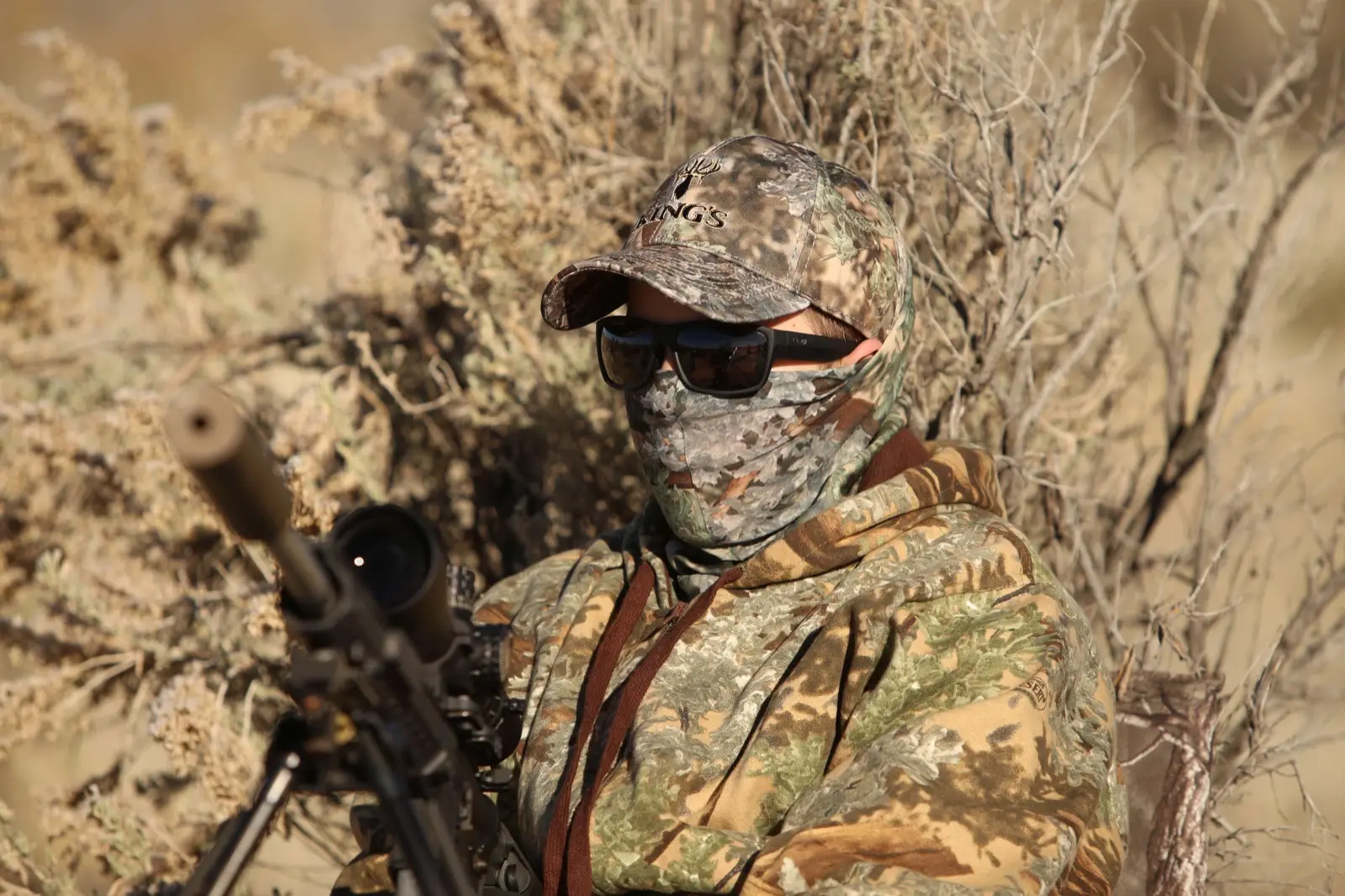
Find a pattern that works for your area, and remember you’ll mostly hunt fall and winter, when nature’s colors fade, so go darker than you think. Take pictures of your terrain from the coyote’s point of view and match the tones. I like King’s Desert Shadow for my country, Mountain Shadow for timber. A lightweight mesh ghillie or 3D leafy suit in a poncho style is another great option, and they don’t pick up sticks and twigs like traditional ghillies.
Cover your hands. You move them more than anything else on stand, and a light skin tone stands out to an approaching coyote. If the sun is on you at all it’s a dead giveaway. I prefer a thin dot-grip glove because it’s cool enough to wear all day and you can still work a call in it. Keep a cold-weather pair in the bag for when the temperature drops.
And wear a face mask. Nothing is more obvious to a coyote than a big human face staring out of a bush, and unless you’re tucked well into shade they will pick it out. A flex-form mask you can pull on and off easily is the one to have: three-quarter if you wear a hat, full face if you don’t.
Chest rigs and lanyards
I ran a call lanyard for years. These days I wear a chest rig instead, and the reason is one word: tethered. When a coyote commits and everything speeds up, that is exactly the moment a rangefinder ends up in the dirt or a remote gets set on a rock and left there. On a short piece of paracord it cannot go anywhere.
What is on mine: the rangefinder, the wind checker and the e-call remote, each hooked on with its own paracord tether. Four to six mouth calls looped on with paracord drops. Extra shotgun shells and rifle bullets in the mag pouches, which is what they were built for. My phone fits too. There is still room for binoculars or my backup FOXPRO Scorpion, depending on what I am walking into.
When I hunt with a partner I add a radio. I run a set of BaoFeng BF-F8HP handhelds. Know this before you key one up: the BF-F8HP transmits on the amateur VHF and UHF bands, and using those legally takes an FCC amateur license. If you would rather not bother, FRS handhelds need no license at all, and you trade range for that. Then check your own state before you carry one on a hunt, because the FCC is not the only rule that touches a radio. Iowa bans two-way radios outright during its two shotgun deer seasons, and Minnesota writes its radio rule around which animal you are after. Your state page is the place to look.
The lanyards did not go in a drawer. I still keep one loaded and ready, and there is one hanging on my rearview mirror right now.
Other coyote hunting accessories
What you wear
- Quality boots — spend the money. At the end of a long day walking in and out of stands you will be glad you did.
- Darn Tough socks — so comfortable, and they don't stink. I've worn them several days in a row and won't go back. More of a comfort sock than a warmth sock.
- Smart wool base layer — another must-have once the temperature drops. Same story as the socks: a couple of days on a long trip and they still don't stink.
- A good pair of sunglasses — critical for me, especially with snow on the ground. You don't want to burn your eyes out on a bright morning. Get them in matte black rather than one of the bright frames, for the same reason you go dark on everything else you wear.
Getting there and back
- VEAGIA range bag — what I would recommend right now: calls, ammo, batteries and the rest of the small stuff that otherwise ends up loose in the truck. The zipper takes a lock, which matters if you leave it in there.
- A sling with some grip — I run one on the rifle and one on the shotgun. A slick sling slides off your shoulder every fifty yards and you end up walking in with a hand on it the whole way. The overmolded Caldwell stays put, which matters more when you are carrying two guns.
- Electronic wind checker — I won't go without one now. Unless you vape, get one of these.
- T-post stepper — we cross a lot of fences and this speeds it up. Be careful with them and keep a hand on the post at all times.
- Coyote drag — once a dog is down, save the energy. It keeps your hands from tiring out putting fur in the truck.
Still deciding on the action? A bolt gun is not the obvious choice any more and it is still the right one for a lot of people. Here is the argument for it.
Keeping the rifle right
- Wheeler reticle level system — a genuinely useful tool for getting a scope mounted straight, which is the sort of thing you only notice when it's wrong.
- Slip 2000 EWL — forget about your gun freezing up in cold conditions. This stuff really works.
- Bore snake & fat wrench — always useful, and both are in my bag on every hunt.
Before you scroll: these tips took a lot of blank stands to learn. I send the new ones out as I find them — get them by email, a few times a season, nothing else.
From the field
Questions and answers from hunters over the years. Comments are closed; contact me if you spot something out of date.
Christopher F. ·
Like learn more about coyote hunting
Thomas N. ·
Great article you covered everything for someone just beginning to a pro. Thinking about getting started in coyote hunting mainly because of the over population of them here around home. Love rabbit hunting and we see less and less rabbits. I guess biggest question I do have is here in Kentucky were I will be hunting not lot of open ground it is pretty thick what do you think would be best gun for hunting? Again thanks a lot for article so glad I came across it.
Joshua S. ·
I use a .223 and take a Mossberg 835 12ga
Andrew C. ·
do you have any free decals?
Chad C. ·
Not yet… maybe soon.
Justin H. ·
Do you have a catalog for coyote hunting year around? Something like buck Master but for coyotes?
Earl C. ·
I am just getting in to coyote hunting
Wayne H. ·
What brand of night hunting light that is kinda on the cheaper side that would be good for us poorer hunters. Thanks for your time
Rob ·
You can get a “Vastfire” light and mount for about 30 bucks on Amazon or Ebay. Good for around 300yrds.
Wayne H. ·
Thanks for 2 work great
Clinton J. ·
I use my Savage .22 lr and my Mark ii 93r17. Should i up my weapons then? They do work but you didnt have them listed in your weaponary list.