
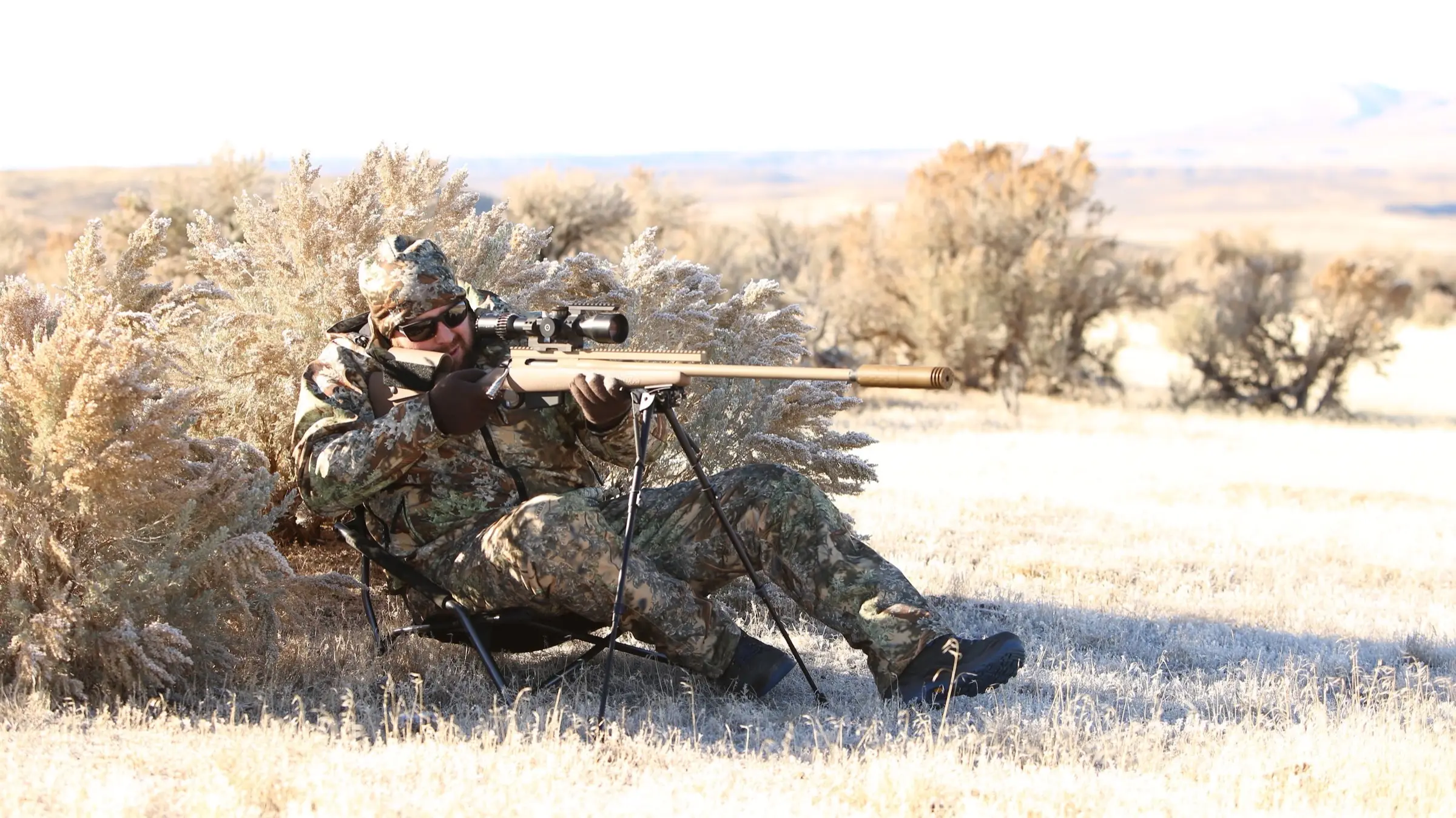
If you’re thinking about coyote hunting, one of the first things you need to consider is your rifle. While there are plenty of options out there, from AR-style semi-autos to lever actions, the bolt action rifle remains one of the most reliable and effective choices for taking down predators. I’ve hunted coyotes for years and have tried my fair share of rifles, but I always come back to my Tikka T3 Lite in .22-250 — the line sells as the T3x Lite now, still chambered in .22-250. I love mine, and I think more predator hunters should seriously consider bolt actions for their setup.
Why use a bolt action rifle for coyote hunting?
Bolt action rifles have been around for over a century, and for good reason. They’re dependable, accurate, and versatile. When it comes to hunting coyotes, those three qualities matter a lot. Coyotes are quick, smart, and wary animals. If you want to be successful, you need a rifle that can make accurate shots at varying distances without failure. That’s where a good bolt action comes in.
Accuracy and precision
Coyotes don’t always give you a second chance. They’re constantly on the move, and if they wind you or catch sight of something they don’t like, they’ll be gone before you can blink. A bolt action rifle, especially one in a flat-shooting caliber like .22-250, allows you to take precise shots from long range. These rifles have fewer moving parts than semi-autos, which means less mechanical variance and better accuracy. If you’ve ever watched a coyote hold up at 200+ yards, you know how important that pinpoint accuracy can be.
Reliability in the field
Another reason I prefer a bolt action for predator hunting is its reliability. Unlike semi-automatics, which can be prone to jamming — especially in dusty, cold, or rough conditions — a bolt action rifle functions smoothly under just about any circumstances. There’s a reason snipers and precision shooters have relied on bolt guns for generations: when you need your rifle to work, they just do. Whether you’re out in freezing temperatures, trekking through thick brush, or dealing with dust, a well-maintained bolt action is going to function without issue.
The calibers worth chambering
Bolt action rifles come in a variety of calibers that are excellent for coyote hunting. My personal favorite is the .22-250, which is an absolute laser beam for predators. It’s got the speed and flat trajectory to make longer shots easier, and it delivers enough energy to drop a coyote in its tracks without excessive pelt damage.
- .223 Remington — readily available and effective, though not as flat-shooting as .22-250
- .204 Ruger — super fast and great for saving fur, though wind can push the lighter bullets
- 6mm Creedmoor — a bit more than necessary for coyotes, but great if you also hunt deer
- .243 Winchester — a solid crossover caliber used for predators and deer for years
- .220 Swift — extreme speed and a flat trajectory, which makes it great at long range
- 6.5 Creedmoor — more commonly used for larger game, but effective on long-range predators
- .17 Remington — a smaller caliber that excels at minimal pelt damage and precision shooting
Whatever your choice, a bolt action rifle lets you take full advantage of these calibers without worrying about cycling issues or reliability concerns. If you want the published chamber and pressure specifications rather than forum argument, SAAMI is where the standards actually live.
The trade-offs
Like anything, bolt action rifles aren’t perfect for every situation. While I love mine and prefer it for most coyote hunts, there are a few things to consider before making one your go-to rifle.
What a bolt gun does better
- Superior accuracy — less mechanical movement means more consistent shots
- Better reliability — no gas system or complicated parts to fail in harsh conditions
- Caliber selection — bolt actions offer more chambering options than most semi-autos
- Lighter weight — most bolt guns are lighter than their semi-auto counterparts
What you give up
- Slower follow-up shots — if you need quick follow-ups, a semi-auto might be better
- Limited capacity — most bolt actions hold 3–5 rounds, compared to 10+ in a semi-auto
- More manual operation — each shot requires you to run the bolt, which takes time
For me, the trade-offs are worth it. I’ve never found myself in a situation where I truly needed rapid follow-up shots on a coyote. If you make your first shot count, the need for a second one should be rare. Yes, I’ve missed out on a very small handful of triples, but I mostly call singles and a handful of doubles.
Making the most of your bolt action setup
If you’re going to run a bolt action for coyotes, there are a few things you can do to maximize its effectiveness.
1. Pick the right optic
A bolt action rifle shines when paired with a good scope. I recommend something in the 3-12x or 4-16x range for predator hunting. This gives you the ability to take both close and long-range shots with ease. A good scope with clear glass and reliable adjustments makes all the difference.
2. Use a good bipod or rest
Coyotes don’t stand still for long. Having a steady rest — whether that’s a bipod, shooting sticks, or a well-placed backpack — will make sure you can make the shot when the opportunity comes. There’s more on what I carry in the coyote hunting gear list.
3. Choose the right ammo
Not all ammo is created equal. For my .22-250, I prefer Hornady V-MAX or Nosler Ballistic Tip Varmint. Both are polymer-tipped varmint bullets built to expand rapidly, which is what gives you quick, humane kills without excessive fur damage.
Winchester Varmint X is worth testing against them — they load it for .22-250, and it is the same idea from a third maker. Buy a box of each and shoot them over the same session. Barrels have opinions, and the only way to find out what yours likes is to let it tell you.
4. Master your bolt work
A bolt action rifle may be slower on follow-ups, but you can train yourself to cycle the bolt quickly. Work on staying on target while running the action smoothly. The more you practice, the more natural it becomes.
Final thoughts: why I stick with a bolt action
At the end of the day, I keep coming back to my Tikka T3 Lite in .22-250 because it simply gets the job done. It’s accurate, reliable, and lightweight, making it perfect for predator hunting. While semi-auto rifles have their place, and some hunters swear by them, I think more coyote hunters should give bolt actions a serious look. If you want a dependable, precision tool for dropping song dogs at distance, a bolt action rifle is tough to beat.
The rifle is only half of it, though — what you call with and when you go out decide whether you ever get the shot.