
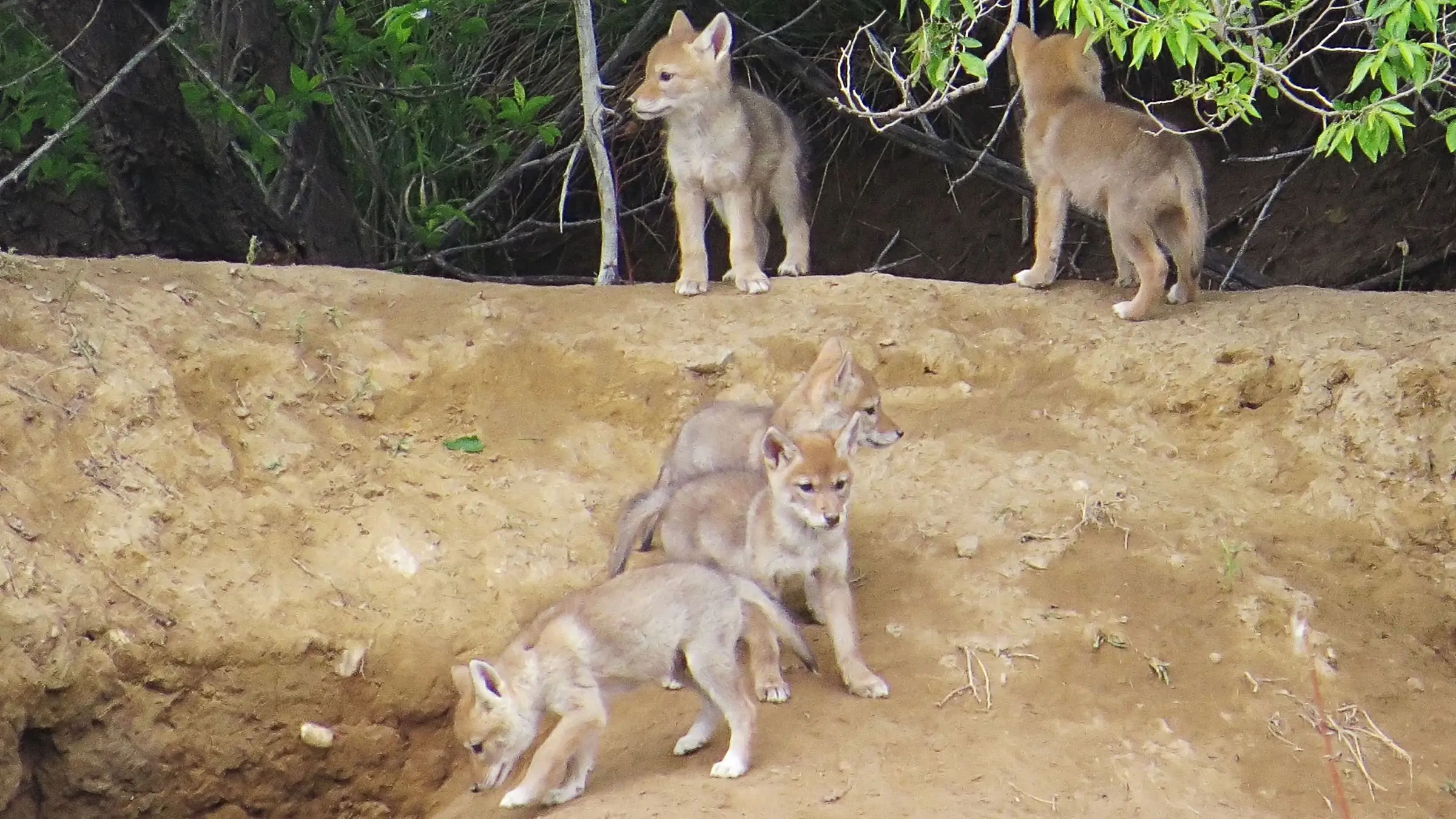
A coyote den is a nursery, not a house. For most of the year coyotes sleep above ground, curled up in thick cover, and the den sits empty. It comes into use a few weeks before the pups are born, in March or April, and the family walks away from it when the pups are eight to ten weeks old.
That one fact changes how you read a hole in a hillside. A den in October is an old den. A den in late April may have a litter in it, and if you poke around, it will not have one by tomorrow.
A den is not a year-round home
Stan Gehrt, who has run the Cook County coyote study in Chicago for decades, puts it plainly in his extension bulletin: denning “is the only time coyotes will voluntarily use a den (they usually sleep above ground in the open or in cover).”
The field numbers line up with that. On Cape Cod, where Jonathan Way and his colleagues collared coyotes through seven springs, pups were born between March 21 and April 12, and families moved out to open, above-ground resting areas between late May and mid-June, when the pups were eight to ten weeks old (Way and others, 2001). Two Maine families left their dens at the same age (Harrison and Gilbert, 1985).
Some coyotes never bother with a hole at all. H. T. Gier, who spent years on coyotes in Kansas, wrote that around Manhattan “it is doubtful that some coyotes ever have dens, as many pups are found in thickets or under brush piles.” In the flood-prone country of eastern North Carolina, coyotes have been found whelping in beds hidden in thick vegetation.
There is one wrinkle. In Edmonton, researchers found 120 dens by following coyote tracks in the snow from January to March, so coyotes visit and clean out den sites in late winter, well before the pups come. Kansas pairs do the same: Gier described them going “house hunting” after breeding, so that “by whelping time several possible dens have been cleaned out.” Tracks into a hole in February do not mean coyotes are living in it. They mean someone is shopping.
Where coyotes dig a den
Three things come up in every study that measured den sites: cover close by, ground that drains, and soil that will hold a tunnel up.
- Cover: on Cape Cod, 16 of 17 dens sat in small openings within 25 meters of dense cover. In Nebraska farmland, 15 of 16 were where two kinds of cover met, often a brome grass edge, and none was in a woodlot.
- Slope and drainage: in Alberta's Elk Island National Park, each 1% of extra slope raised the odds of a den by 21% (Raymond and others, 2026). On Cape Cod, 16 of 17 dens were on mounds, ridgetops or dunes.
- Something to hold the roof: 96% of the Alberta den openings were braced by tree roots, beaver-cut wood or rock. On Cape Cod, 15 of 17 were dug into root systems in sandy soil. Nobody found a den in soft organic ground.
A lot of dens start as somebody else’s hole. In southeast Nebraska most den burrows looked like they had been dug by badgers the year before (Althoff, 1980), and the old federal den hunters found coyotes “will enlarge abandoned badger or rabbit holes or use deserted porcupine dens” rather than dig fresh. Others are not burrows at all. In Atlanta, 9 of 20 dens with pups were man-made spaces: concrete rubble, a road culvert, an overturned boat, a tractor tire (Fink and others, 2026).
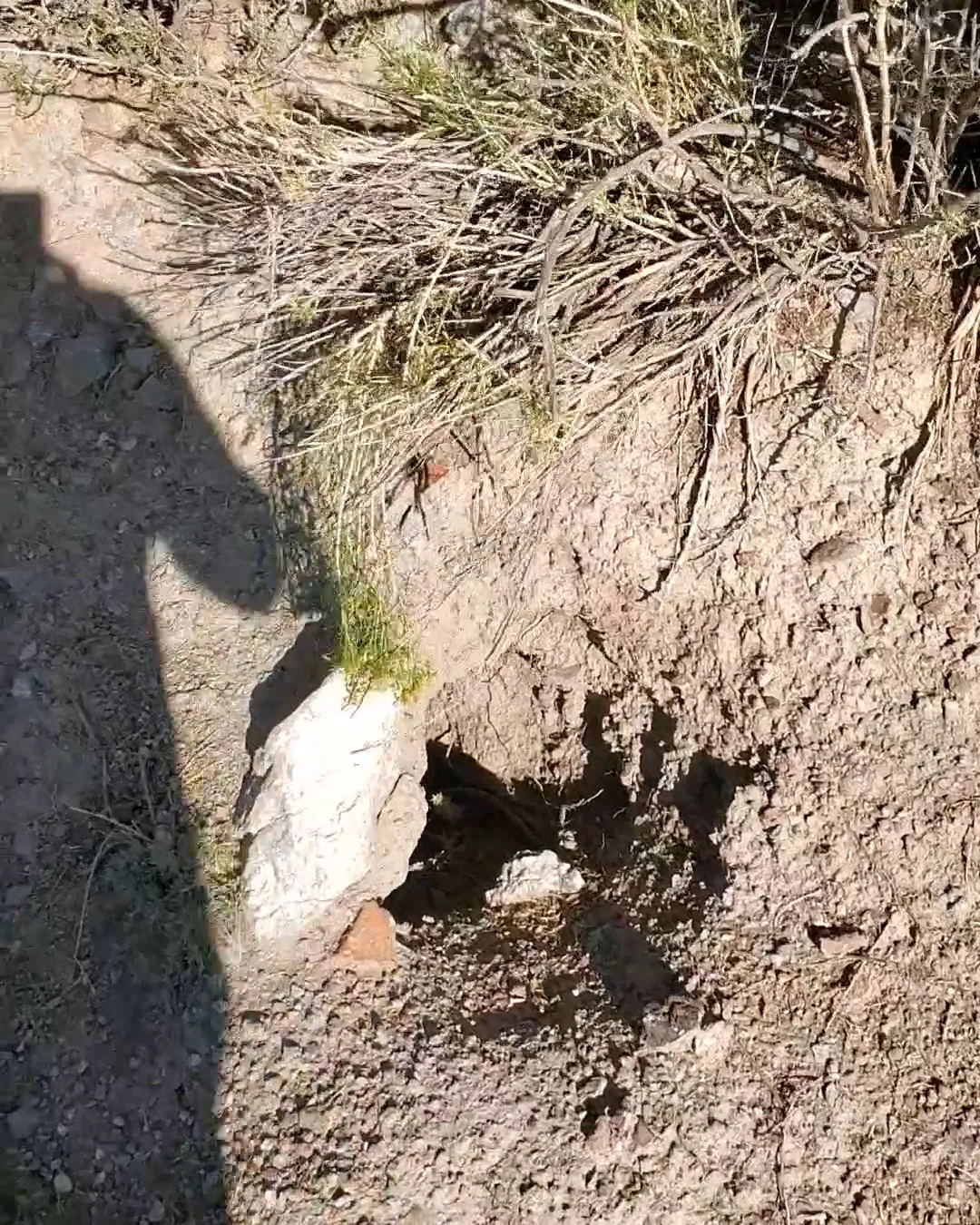
Another den the same day, tucked under the brush behind a white rock. I found the den first and the spring a short walk away after.
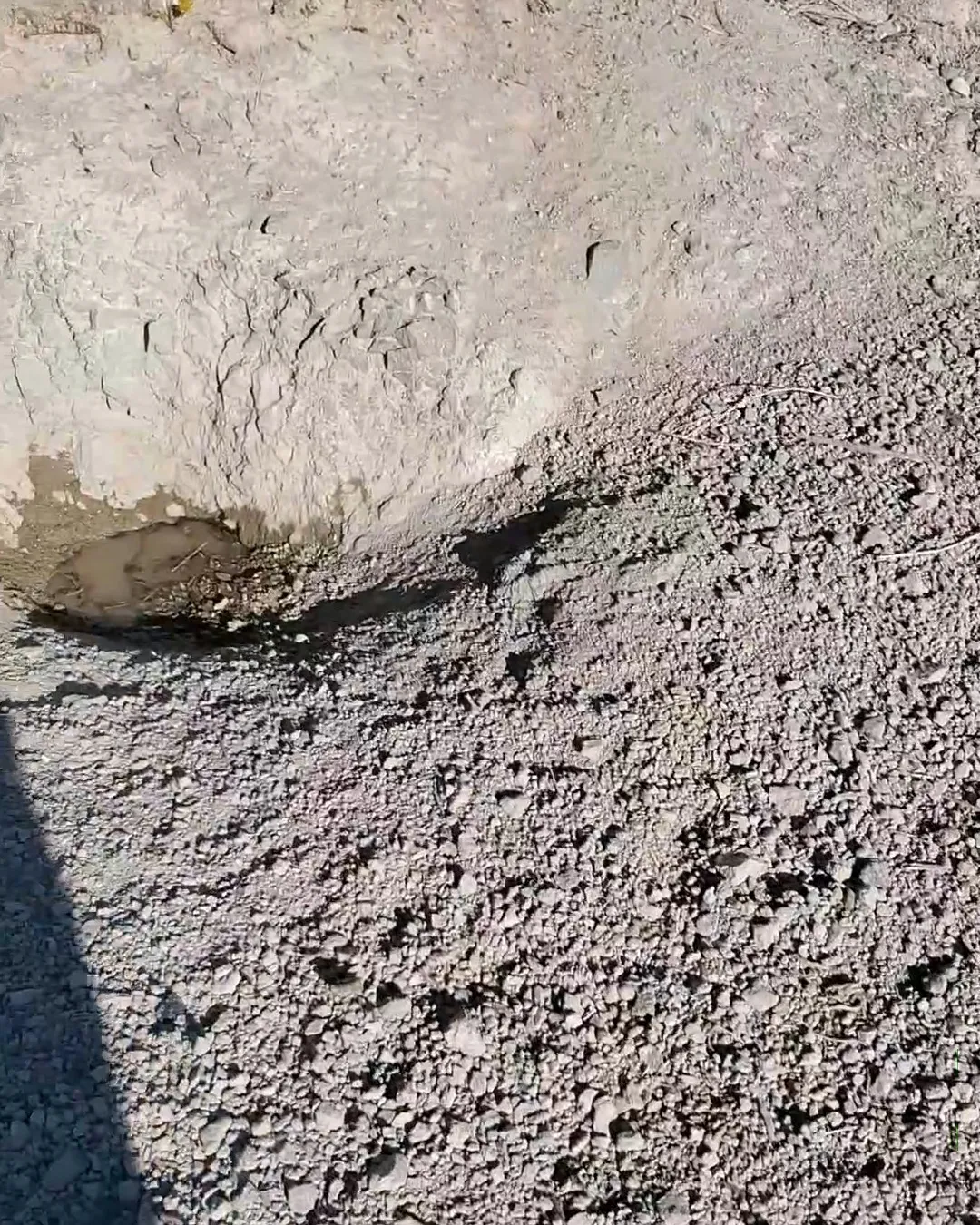
The spring near that second den: a seep pooled under the bank, the only water around.
Water and people vary more than you would think. Every Cape Cod den was within 300 meters of water, while in Nebraska more than half were 200 meters or more from it. Rural Nebraska coyotes kept at least 400 meters from occupied farmsteads. City coyotes do not: Atlanta dens averaged 135 meters from the nearest building, and in Edmonton most were within 100 meters of one.
Do dens face south for the sun? Some do. The older Kansas, Missouri and Saskatchewan studies reported most dens on south-facing slopes, and six Maine den entrances all faced between southeast and southwest. But when later researchers took compass bearings and tested them, the pattern did not hold: Nebraska dens faced mostly north and east, Edmonton dens east, and Cape Cod and Elk Island dens showed no preference at all. Slope and cover predict a den far better than direction does. Althoff thought shelter from the prevailing southwest wind might matter more than the sun.
What a coyote den looks like
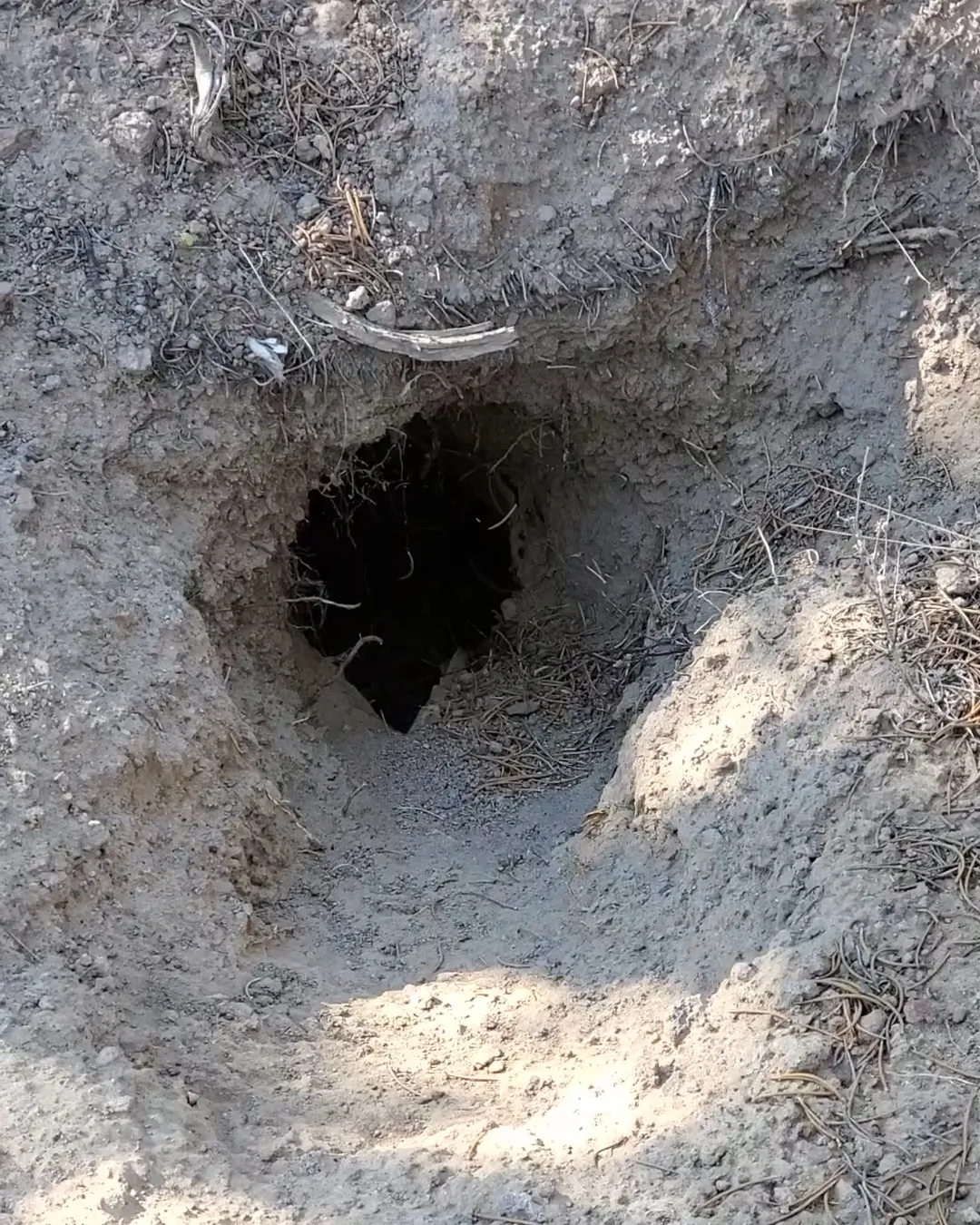
A den I found in the pinyon and sage in early October, empty, the way most dens are by fall. The worn trough and the fan of dirt down the slope are what to look for.
A coyote den entrance is a hole about the size of a dinner plate, usually with one opening in use and a fan of fresh dirt in front of it.
The measured entrances are remarkably consistent: 28.9 centimeters across on Cape Cod (17 dens), 29 wide by 27 high in Alberta (42 dens), 32 centimeters in Nebraska. Call it 11 to 13 inches. Atlanta’s ran wider, around 55 centimeters, because so many were gaps in rubble and concrete. Most have a single entrance: all 17 on Cape Cod and three quarters of the Alberta dens.
Behind it, tunnels usually run 2 to 5 meters. Gier dug one in a sandy Kansas bank that went nearly 30 feet with two side branches; others were 3 or 4 feet and straight. The nursery is just a wider spot near the back. In the six Nebraska dens Althoff dug out completely, the chamber sat 2 to 4 feet below the surface and was 7 to 20 inches tall. There is no nest. The 1937 den hunters wrote that “the only thing provided in the nature of a nest is an enlarged section of the den, and some dens do not have even this.”
You will often read that a coyote hole is taller than it is wide. The measurements say otherwise. The holes researchers actually measured were round, or a little wider than tall. What is wider than tall, flat-floored and scored with claw marks is a badger hole.
Coyote den or fox den?
The best tell is housekeeping. A coyote den is clean.
Cape Cod’s 17 dens were “devoid of prey remains and adult scats,” the same thing the Maine study found, and the old federal den hunters said coyotes “are clean about their dens; so there is little refuse or odor.” A red fox den is the opposite: SUNY ESF’s red fox account describes “accumulations of parts of prey, feces, and urine,” and the EPA’s den cartridge label tells applicators that fox dens are “marked by remains of prey.”
| Coyote | Red fox | Gray fox | Badger | |
|---|---|---|---|---|
| Den | Enlarged burrow of another animal, a hole under roots or rock, culverts and rubble in town | Remodeled woodchuck or skunk burrow on a drained slope or knoll | Rock piles, brush piles, hollow logs and trees; rarely a burrow | Digs its own |
| Entrance | About 11 to 13 inches, round or slightly wide | 8 to 15 inches | Usually not a burrow | Wider than tall, flat floor, claw marks |
| Openings | Usually one in use | Two or more | n/a | Usually one per den, plus many shallow digs |
| Around the hole | A dirt mound, worn trails, loose hair, very little food waste or smell | Prey remains, scat and urine | Den lined with leaves or bark | A dirt mound, often among other fresh holes |
One state agency, Washington’s, says bones, feathers and fur can be seen next to coyote den entries. Once pups are out and the parents are carrying food in, that can happen. But a hole surrounded by scattered prey is more likely a fox than a coyote.
They keep more than one den, and they move
A coyote family rarely raises a litter in one hole. Females clean out several before the pups come, and the old den hunters said “sometimes a dozen or more.”
Then they move the pups, and the best-documented trigger is people. On Cape Cod, every known human disturbance at a den, seven of them, was followed by the family moving the pups, anywhere from 50 meters to a kilometer away, and one family went four kilometers to a resting area the night after. Gier warned that a den found with pups in it “is likely to have no pups in it within an hour if left unattended.” Families move without being disturbed too, which is why the Cape Cod researchers called the cause-and-effect “speculative.”
You will also hear that they move to get away from fleas. It comes from the 1937 den hunters, who thought families sometimes moved “apparently just to have a cleaner home, leaving many fleas behind.” It is a reasonable guess. Nobody has tested it.
Dens get reused from year to year, and families return to the same general area, but no study has measured how often the same hole is used again. Helpers are real: on Cape Cod, at least two young coyotes from the year before helped a female feed her litter, and the breeding males were at the den or the resting site in more than half of all their locations, every month of the summer.
How to find a coyote den
Researchers mostly cheat. They put GPS collars on adults, wait for a female to stop moving in spring, and walk to the spot. In Atlanta a den candidate was five or more locations within 60 meters over a week, and the searchers then looked for “recent digging, holes or tunneling… hair on roof entrance, tracks… nearby scat, trailing into entrance, or smoothed dirt.”
Without a collar, the old method still works, and it is the same sign:
- Paired tracks that turn into a trail: the 1937 manual says a mated pair's tracks "begin to form a trail within a quarter of a mile from the dens." Look after a rain and around water.
- Freshly cleaned holes: a den is usually within about a mile of holes that have been dug out recently.
- A dirt mound the adults walk around, not over, and a smooth, worn entrance with hair caught at the top.
- Pups give it away: once they are out, the grass around the den is trampled flat, there are small tracks and small scat, and you can sometimes hear them as you get close.
- Howling gives a direction, not a location. The adults tend to answer near the den early in the morning.
If you are scouting in spring and find one, back out. You will learn more glassing it from a distance over a couple of mornings than walking up to the hole, and the scouting guide covers how to read the ground around it.
The pup timeline
Pups are born from mid-March into May, most of them in April. The mating season article has the dates for every state.
- About 3 weeks: pups first come to the mouth of the den.
- About 6 weeks: weaned, and eating food the adults carry in or bring up.
- 8 to 10 weeks: the family leaves the den for above-ground resting areas, late May to mid-June on Cape Cod.
- Late summer: pups follow the adults and start hunting.
- From about 5 months: young coyotes start to leave. In Maine, [dispersal](https://www.maine.gov/ifw/docs/coyote-speciesassessment.pdf) began in late September and peaked in October and November, with a second wave in February and March.
While they are raising pups, the adults stay tied to the den but still cover a lot of ground. In the Georgia Piedmont, breeding adults moved 5.4 to 6.1 kilometers a day and used about 21 square kilometers over the pup season (Chamberlain and others, 2021). In Ohio’s Cuyahoga Valley the pup-season ranges were smaller, 4 to 5 square kilometers. Through spring the den is the middle of the family’s ground, not the edge of it.
A coyote den in your yard
Under a shed, a deck or a porch is a common spot in town, and state agencies do not all give the same advice.
New York’s DEC tells people during April to June to stay away from the spot, keep pets away, and wait: “In time, the coyotes will move on, as coyotes often move their den site.” Missouri’s Department of Conservation coyote guide notes that “human disturbance at the den site usually will cause coyotes to move the pups,” and that coyotes with pups “sometimes become aggressive to dogs that come near their dens in April and May.” Colorado Parks and Wildlife says landowners may leave the den or haze the family away, then fill the hole once tracks stop showing for a day or two.
What every agency agrees on: keep dogs and kids clear of the area from April through June, and block the space under decks and sheds before spring so there is nothing to move into.
The law on dens
There is no single rule, and it turns on a detail most people never look at: whether your state calls the coyote a furbearer.
- Missouri: "The dens or nests of furbearers shall not be molested or destroyed," and the coyote is a listed furbearer (3 CSR 10-7.450). Missouri also closes daylight coyote hunting from April 1 to the spring turkey opener. More on the Missouri page.
- Ontario: no one may "intentionally damage or destroy the den or habitual dwelling of a furbearing mammal, other than a fox or skunk," without a trapping licence, and the coyote is on the list (Fish and Wildlife Conservation Act, s. 8).
- Nebraska and Kansas: both protect the dens of furbearing animals (Neb. Rev. Stat. 37-533, K.S.A. 32-1015), but neither state's definition includes the coyote, so those rules cover fox and badger dens, not coyote dens.
- Colorado: the state's own guidance lets landowners remove a coyote den on their property once the family has left, and allows coyotes causing damage to be taken on private land without a hunting license. See the Colorado page.
Den fumigation is its own category. The gas cartridges used on dens are EPA-registered pesticides, labeled for use only in dens “known to be in active use by the target species,” outdoors, and never under buildings, and one version is sold only to USDA Wildlife Services.
If your state is not on that list, do not assume anything either way. Check your own state’s page on the state regulations index, and when in doubt call the agency before you touch a den.