
Three parts of this series have been about food. This one is about the fact that food is not enough.
Part two closed on a finding from seven years of camera trapping in the Chihuahuan Desert that I have not been able to put down. Jackrabbits and cottontails responded to wet summers by getting more numerous, but only where there was shrub cover. In the open grassland, which had more to eat in it, they did not. The authors’ explanation is that prey abundance “will be greater in habitats perceived as safe because of shifts in habitat selection to avoid predation, even if safer habitats have lower food resources.”
Read that as a hunter and it says something useful. The best feed on your property is not where the animals are. The animals are wherever they can eat and still get to cover, and that is a narrower piece of ground than either the feed or the cover.
That narrow piece is the transition, and it is the whole reason a coyote walks the line he walks.
The seam
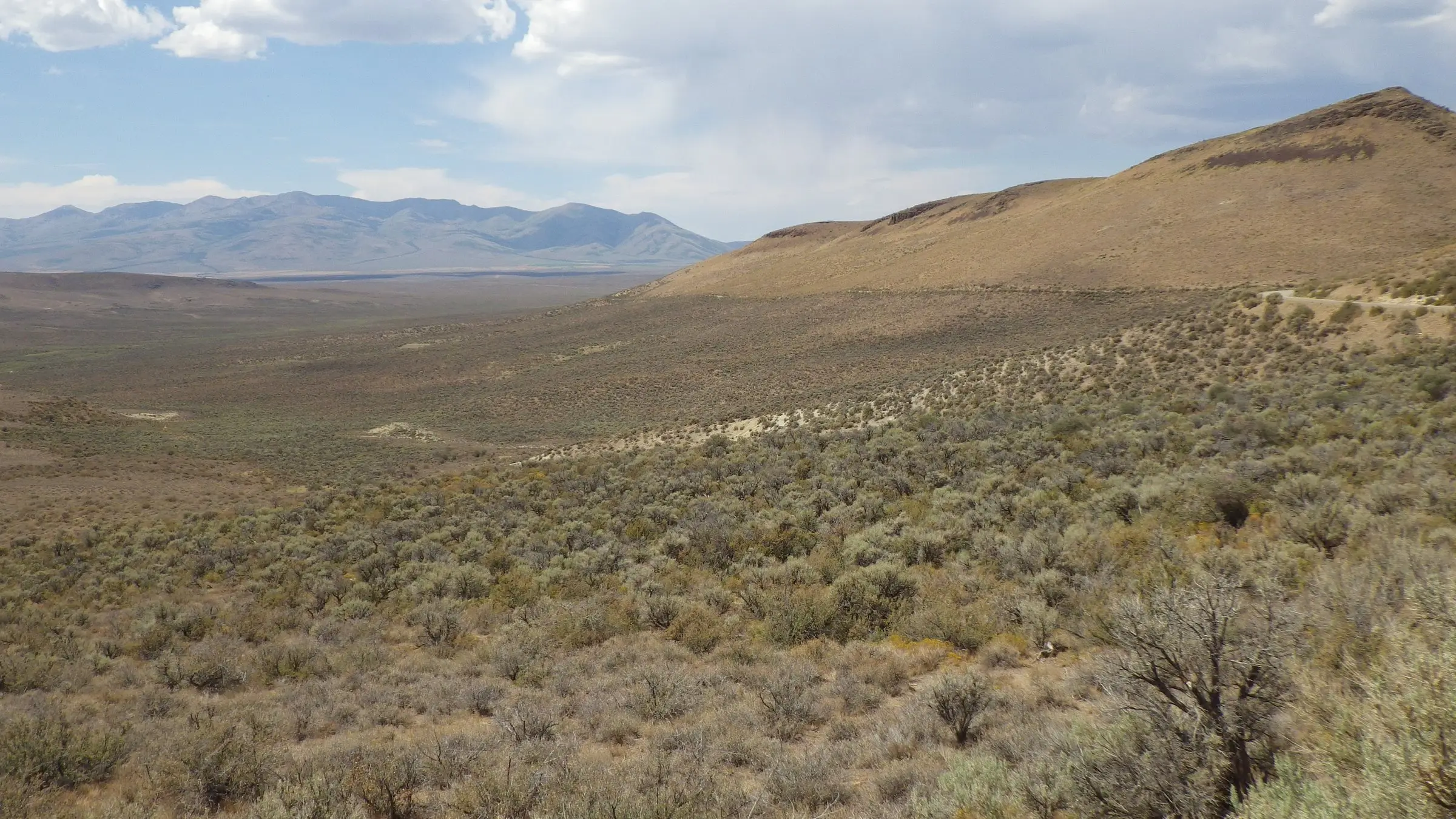
A transition is just the place where two kinds of country meet. Brush and grass. Timber and field. Sage and flat. Creek bottom and hillside. The name in the literature is an ecotone and the name on most ranches is the edge, and it is worth being precise about why it concentrates animals, because “edges are good” is the kind of advice that gets repeated without ever being cashed in.
The reason is that the prey species stack up there, and they stack up for different reasons.
Work down that diagram and you can see why the seam is worth more than either side of it.
The cottontail and the cotton rat never really leave. A desert cottontail seldom ranges more than twelve hundred feet from its thicket, and a cotton rat wants a protective canopy of grass over its head the entire time. For them the edge is the outer limit of the world.
The jackrabbit and the hare use both ends and ignore the middle. They bed in the cover through the day and move out to feed at night, and the Forest Service puts that movement at two to ten miles. The edge is not where they live. It is what they cross, twice a day, at predictable times.
The voles are wherever the dead grass is, which is usually the unmown strip along the edge rather than the grazed field or the shaded understory.
The mice are everywhere, which is why part one found small mammals to be the most consistently eaten food in every ecoregion on the continent.
Four different animals with four different reasons, and one strip of ground where all four are available at once. A coyote does not need to understand any of that. He only needs to have learned that walking the line produces more than walking either side of it.
Fear is what builds the seam, not food
This is the part that changed how I look at a piece of ground, so it is worth the space.
That study was built on a companion piece that did something clever: it measured how frightened the rabbits were. The authors report that “perceived predation risk in jackrabbits and cottontails was quantified with more than 200 trials of flight initiation distances, and for both species, their perceived risk was negatively related to shrub cover.”
Flight initiation distance is simply how close you can get before the animal runs. More shrub cover, shorter distance, calmer rabbit. That is fear, measured with a tape.
And the fear is what decides where they are, not the groceries. In the good years, when there was plenty to eat, the lagomorphs concentrated in the brush and left the richer grassland alone.
A controlled experiment in Ecology and Evolution shows the same thing at the scale of a single feeding animal. Ferreira, Dammhahn and Eccard gave voles identical food patches in landscapes they had been made to perceive as either safe or risky. In the safe version the voles “increased time spent in patches, lowered GUD and visited distant patches more often compared to risky landscapes.” GUD is giving-up density, the food left behind when an animal decides the patch is no longer worth the risk. In the risky landscape the food simply did not get eaten. The authors put it plainly: “higher densities of resource levels remained in risky landscapes.”
So the feed being there does not mean the feed is being used. An animal in country it does not trust eats a little and leaves. That is the difference between a field with rabbits in it and a field with rabbit food in it, and from the truck the two look identical.
The coyote already knows which is which. He has walked it.
Corners beat lines
Once you accept that the seam is the thing, the next question is which seam, and there is a simple answer that costs nothing to apply.
Two kinds of country meeting gives you a strip. Three kinds meeting gives you a spot, and a spot is worth more for a reason that has nothing to do with prey density: a coyote passes through a strip and works a corner. The difference between an animal crossing your shooting lane and an animal hunting inside it is most of the stand.
There is research behind the same instinct. The Arches work in part two found that kangaroo rats in a single-species blackbrush stand boomed and crashed with the seed crop, while “in mixed desert vegetation, kangaroo rat abundance was higher and more uniform through time.” More kinds of plant, steadier prey, year after year. A corner where three habitats meet is a small piece of mixed country by definition.
So when you are picking between spots, count the habitat types you can touch from where you would sit. Two is normal. Three is worth walking to.
What to actually look for
The seam looks different depending on where you hunt, so here is the same idea in several dialects.
- Great Basin and sage country — where heavy sage thins into flat, the lip above a dry wash, the base of a rimrock, a spring seep with green around it
- Desert Southwest — mesquite bosque into open desert, the bank of an arroyo, a bajada where the brush changes with the slope
- Great Plains — a shelterbelt and the crop beside it, a coulee running up out of the flat, the line between grazed and rested pasture
- Midwest farm country — a fencerow, a grassed waterway, a CRP field against standing corn, the ditch nobody mows
- Eastern hardwoods — a field edge, a clearcut against mature timber, an overgrown orchard, a power line right of way
- The South — a pine plantation edge, a field border in broomsedge, the lip of a creek bottom
- The north woods — a cut against standing spruce, a beaver meadow, an alder run along a stream
Every one of those is the same thing: a place where an animal can feed and reach cover in one movement. The plants change and the geometry does not.
Two extras that beat all of them when you find them. Anywhere three types meet, per the diagram above. And anywhere a linear feature runs through a seam, because a fence, a two-track, a ditch or a stream gives a coyote a travel route that stays in the profitable band instead of crossing it.
The drought exception, and it matters
Here is the part of the Chihuahuan study that most people would skip, and it is the one that will save you a season.
The rabbits preferred the brush in the good years. In dry years the pattern broke:
“Lagomorphs were relatively more common in grasslands in dry years… lagomorphs may tolerate greater risk when resources are limited. During droughts, herbivores may be forced to trade-off risk in favour of more abundant forage.”
When there is enough to eat, a prey animal buys safety. When there is not, it spends safety to get fed. So the seam tightens in a wet year and loosens in a dry one, and the animals push further out into open country in a drought than they ever would otherwise.
Practically: in a good year, hunt tight to the cover and expect short approaches. In a dry year, do not assume the empty-looking flat is empty. That is where the feed is, and hungry animals are out in it further from the brush than the rule says they should be.
The same logic runs the other way in deep snow. Part three covered it. Snow buries the small stuff and pushes everything toward carrion, and the seam that matters in February is often the one between the wind-scoured slope where something can still feed and the timber where it can bed.
Setting up on a seam
Finding it is most of the work. The rest is not giving it away.
Three things in that picture need spelling out.
Sit in the open looking back at the cover, not in the cover looking out. It feels wrong, because the cover is where you want to hide. But your scent has to go somewhere, and if you are tucked into the brush with the wind at your back, it is going into exactly the ground he is coming from. Out in the feed, the cone lands on bare country he was not using.
He is going to swing downwind of the caller. Plan the stand around that, not around the caller. The question is never whether he checks. It is whether the checking happens somewhere you can see. That is what the partner sitting wide is for, and it is why the downwind gun is the one that gets the shooting.
Put the caller between you and the cover, not beside you. Distance out to the call buys you the seconds between him committing and him being close enough to sort out what you are.
For the mechanics underneath all of this, the volume, the sequence and how long to sit, part four of the tips covers it in order, and what to play by month covers the sound.
What this changes
The whole series comes down to four sentences.
Coyotes eat what the country offers, and the country changes by region. Rabbits in the deserts, deer and mast in the eastern and northern forests, rodents everywhere and always.
The prey animals are where the plants are, so the prey base is legible in daylight from a road, months before you hunt it.
But prey do not go where the food is best. They go where they can eat and still get to cover. That is a narrower place, it is usually a poorer place, and it shifts outward in a drought and inward in a good year.
So hunt the seam, favor the corners, and set up so the ground you give away is ground he was never going to be standing in.
None of that replaces time on the ground. It tells you which ground to spend the time on, which is the only part of this that a piece of writing can honestly do for you.
If you want the walking-around version of finding country, scouting for coyotes is the practical companion to all four of these. And check the rules where you hunt before you act on any of it.