
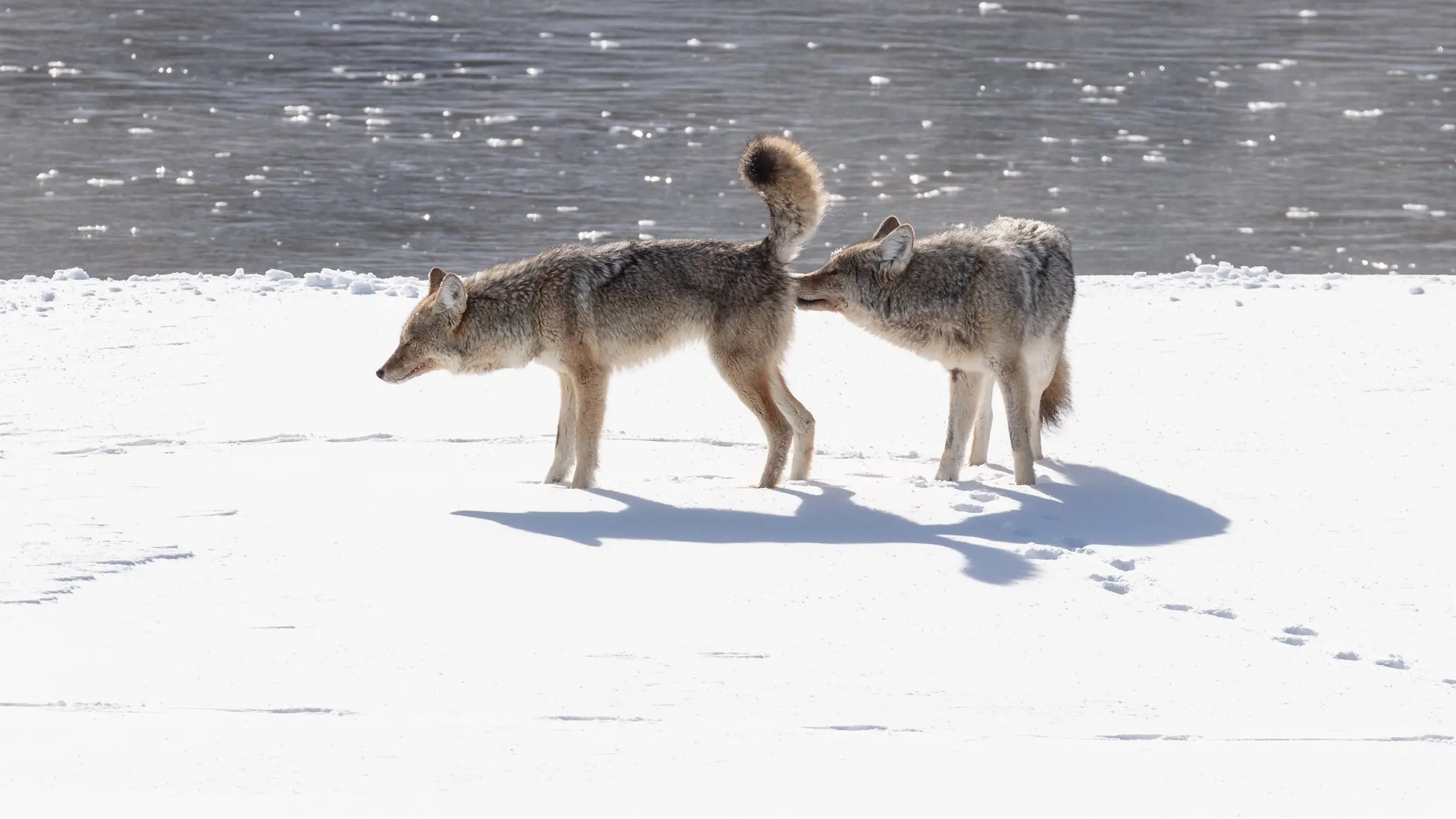
Coyotes breed once a year. The female comes into heat for about ten days, sometime between early January and late March, and in most of the country February is the month it happens. Pups are born about two months later, from March into May.
That is the answer most people are after, and it holds from Texas to Ontario. The two things people believe on top of it, that the season runs later the further north you go and that coyotes sometimes throw a litter in summer or fall, are where it gets interesting, because the studies that actually measured it do not back either one.
The short answer
- Breeding: January through March, most of it in February.
- Heat: one a year, about ten days long, after a slow build-up of two to three months.
- Gestation: about 60 to 63 days, call it two months.
- Pups born: March through May, most of them in April.
- Young females: a first-year female breeds a week to three weeks later than an older one, and some do not breed at all.
The newest authoritative review, Gese and Patterson’s coyote chapter in Wild Furbearer Management and Conservation in North America, puts it in one line: breeding “between January and March, depending on geographic locale,” with litters “typically born March–May after a gestation period of 60–63 days.”
One heat a year
A coyote is not a dog. A domestic dog cycles roughly twice a year, any time of year. A coyote cycles once, in winter, and so does the male.
Carlson and Gese tracked hormones, behavior and vaginal cells in captive pairs at the USDA’s predator research facility in Utah, and the summary of their 2009 paper is blunt: “Coyotes also are monestrous, and both sexes are fertile only in winter.”
The male side is just as seasonal. A study of captive males at Utah State found testosterone peaking in January, testicle size peaking in February, and sperm production shutting down after the season (Minter and DeLiberto 2008). A wild California sample found 96% of adult males reproductive from January to March (Sacks 2005). Outside that window a male coyote has nothing to offer.
If a female is not bred, she does not try again. She goes through a false pregnancy instead, hormonally almost identical to the real thing, and in Carlson’s captive colony not one unbred female came back into heat later in the year. They stayed with their mates, and the males kept bringing them food as if pups were coming.
The build-up is long. In the captive work, courtship and the slow rise toward heat ran two to three months ahead of the ten days that count. A pair you see traveling together in December is already partway there.
Does the season run later the further north you go?
No. Or at least, nothing measured says so.
It is a common belief and it sounds right, because spring comes later up north. But when you line up the studies that measured breeding or birth dates, the dates do not sort by latitude.
| Where | Breeding | How it was measured |
|---|---|---|
| Washington and Montana | February, Montana averaging February 15 | Embryos and den litters, federal records |
| Utah (captive) | Mid-January to mid-February | Hormones and behavior, 32 pairs |
| West Virginia | January 6 to February 26, averaging early February | Fetal measurements |
| Arkansas | Mid-February to the first week of March | Reproductive tracts, 263 wild canids |
| Texas (captive) | Late February to early March | Hormones and vaginal cells |
| Central California | Early January to late March, from births of March 9 to May 7 | 441 wild coyotes |
Montana and Washington sit at the top of that table and breed in February. Arkansas, a thousand miles south, breeds a little later, not earlier. A captive Texas colony came into heat after a captive Utah one.
The only historic federal comparison says the same thing in plain words. The Bureau of Biological Survey’s 1937 den-hunting leaflet, working from embryo records collected across the West, put Montana’s breeding “about February 1” lasting the month, with the average on February 15, and found that “the season in the northern tier of States seems somewhat earlier than farther south.” Texas, it said, “seems to begin somewhat later,” though the authors admitted their Texas data were thin.
So where does the north-is-later idea come from? Probably wolves. In gray wolves it is real: wolves breed earlier at lower latitudes, a pattern Mech documented from 12 to 80 degrees north. Nobody has found the same gradient in coyotes.
What does move the date is age and place. Young females breed later than old ones, by ten days to two weeks in the 1937 records and three to four weeks for first-year animals in California. Elevation and local conditions matter too: the same federal records show a spread of “at least 2 months” within Oregon and within Arizona, with the early coyotes in Oregon coming out of the low sagebrush desert in the southeast.
Do coyotes ever breed out of season?
Not that anyone has documented in a wild coyote.
There is no confirmed record of a wild coyote litter born in summer or fall, and none of a wild female raising two litters in one year. Given that females cycle once and males are only fertile in winter, that is what you would expect. A litter that seems to show up in September is almost always an April litter that grew faster than the observer thought. Coyote pups are close to adult size by early fall.
The stories that do have something behind them:
- Coydogs in captivity: Mengel's study of dog-coyote hybrids, bred in Kansas in the 1950s, found the hybrids had "a late autumnal, annual mating season (in this case in December)." Pups born in midwinter, with no help from the father, were his explanation for why coydogs do not take hold in the wild.
- But not in the wild: in Arkansas, where hybrids were sampled from the wild, their breeding season "overlapped with those of coyotes" (Gipson and others, 1975). The claim that coydogs breed year-round, or twice a year like dogs, has nothing behind it.
- One long heat: a single female was recorded mating in mid-January and again in late March of the same winter (Harrington and others, 1987). Two heats or one stretched one, it was still inside the normal window.
- A drug can fake it, not finish it: captive females given a reproductive hormone in October started courting and tying with their mates. None got pregnant (Carlson and Gese 2009).
You may also see a Mexican study quoted for coyotes in heat in October and November. It rests on vaginal smears alone, lumps the months together, and lists October although the authors only trapped from November to May. It does not show autumn breeding.
What breeding season changes on a stand
The months around breeding are when coyotes are most invested in each other and in their ground, and that shows in what they do.
Spontaneous howling and scent marking climb at the start of the breeding season. In Yellowstone, Gese found territory defense was highest “during and immediately after the breeding season and during the time of pup emergence from the den.” A resident pair that will not tolerate a stranger is a pair that can be pulled with a challenge or a coyote vocalization they would ignore in October.
Here is the part that runs against what most of us were told. When biologists play recorded howls and count the answers, winter is the worst season for replies, not the best. In a year of broadcasts in south-central Indiana, coyotes gave 46% of their answers in summer and 3% in winter. A Michigan study of collared coyotes found replies climbing from June to a peak in August. Those surveys measured coyotes howling back at night, not coyotes coming to a call, and that is a different decision for the animal. But it is a good reason not to read silence on a February stand as an empty section.
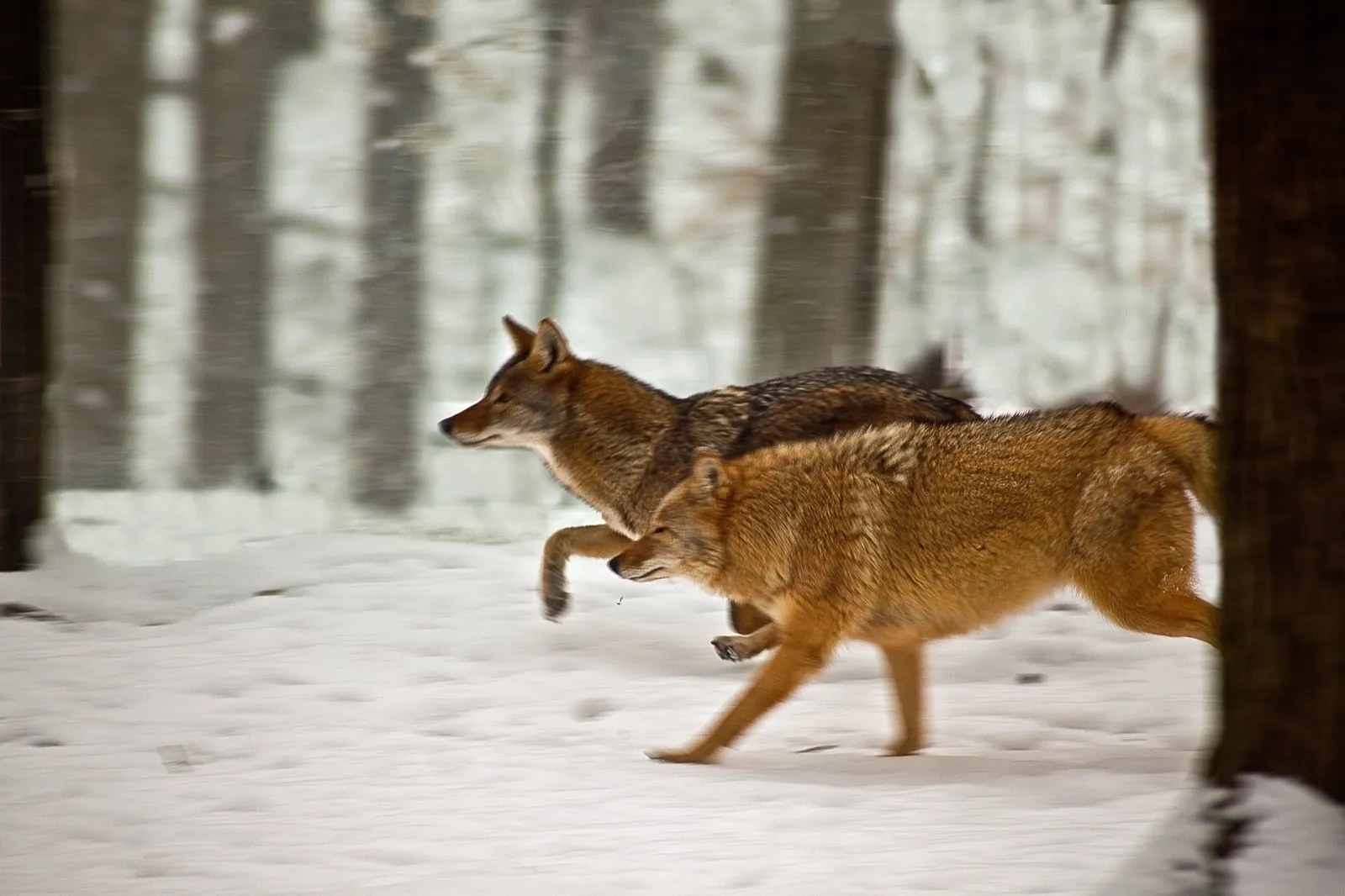
A pair on the move through snowy woods in West Virginia in January. Photo by ForestWander, CC BY-SA 3.0 US.
Daytime movement picks up too. A south Texas study summarized in the Forest Service’s species review found coyotes more active by day during the breeding season, which fits what most hunters notice: February is when you start seeing pairs crossing open ground in daylight. If you are planning when to go, when to hunt coyotes lays out the whole year, and confidence calls are worth having in the truck for the pressured end of the season.
Pup season
Two months after breeding, the female dens up and the pups arrive. Most are born in April. In Atlanta, researchers who checked dens and aged the pups found Georgia coyotes giving birth “from mid-March to mid-April” (Fink and others, 2026). In West Virginia the measured births ran from March 10 to April 30. In California, March 9 to May 7.
The pups stay below ground for about three weeks, are weaned at around six, and leave the den for above-ground resting spots at eight to ten weeks. By the time they disperse, from about five months on, most of them are hard to tell from an adult at a distance.
That is also the stretch when coyotes are most defensive. A review of 367 coyote attacks on people found more of them from March through August, the breeding and pup-rearing season, than from September through February (Baker and Timm). If you are scouting in spring and walk into a family’s den area, expect to be barked at and followed out.
Pup season is also when a few states shut the door. New York’s season closes on March 28, and Missouri closes daylight hunting from April 1 to the spring turkey opener. The breeding season is biology and the hunting season is law, and the two calendars rarely line up: most states stay open straight through denning. Check yours on the coyote season by state map before you plan anything for April and May.
The table below gives every state and province. Where somebody measured the dates, that study is the source. Where nobody has, it is what the state’s own agency publishes, and for the Southeast that is worth saying plainly: a regional synthesis by the southeastern wildlife agencies says “the exact timing of breeding by coyotes in the southeastern U.S. is relatively unknown.” Most of the dates there are the general rule, repeated.
Every state and province
Where a study measured the dates, that study is the source. Otherwise it is what the state or provincial agency publishes. Each name links to that state's hunting laws.
Pacific coast
| Where | Breeding | Pups born | Source |
|---|---|---|---|
| Washington coyote hunting | February | April | Hamlett 1938, USDA Tech. Bull. 616Measured study |
| Oregon coyote hunting | February, a few in January | April, a few in March | Hamlett 1938, USDA Tech. Bull. 616Measured study |
| California coyote hunting | Early January to late March | March 9 to May 7 | Sacks 2005, Journal of MammalogyMeasured study |
Rockies and Great Basin
| Where | Breeding | Pups born | Source |
|---|---|---|---|
| Idaho coyote hunting | Late February to early March | March to May | Idaho Fish and GameAgency |
| Montana coyote hunting | February, averaging February 15 | About two months later | Young and Dobyns 1937, USDA Leaflet 132Measured study |
| Wyoming coyote hunting | Not published | Not published | Nothing published |
| Nevada coyote hunting | January to March | About two months later | Nevada Department of WildlifeAgency |
| Utah coyote hunting | Mid-January to mid-February (captive colony) | March to April (captive colony) | Carlson and Gese 2008, Journal of MammalogyMeasured study |
| Colorado coyote hunting | January to March | April to mid-May | Colorado Parks and WildlifeAgency |
Desert Southwest
| Where | Breeding | Pups born | Source |
|---|---|---|---|
| Arizona coyote hunting | January to March | March to May | University of Arizona Cooperative ExtensionAgency |
| New Mexico coyote hunting | Not published | Not published | Nothing published |
| Texas coyote hunting | Mid-January to early March | April (south Texas, measured) | Knowlton 1972, Journal of Wildlife ManagementMeasured study |
Great Plains
| Where | Breeding | Pups born | Source |
|---|---|---|---|
| North Dakota coyote hunting | January to March | March to May | North Dakota Game and FishAgency |
| South Dakota coyote hunting | Not published | Not published | Nothing published |
| Nebraska coyote hunting | Not published | Not published | Nothing published |
| Kansas coyote hunting | Late January to early March, peaking mid-February | Early April to mid-May | K-State Research and ExtensionAgency |
| Oklahoma coyote hunting | Not published | Not published | Nothing published |
Midwest
| Where | Breeding | Pups born | Source |
|---|---|---|---|
| Minnesota coyote hunting | January to February | April | Minnesota DNRAgency |
| Wisconsin coyote hunting | February or March | April | Wisconsin DNRAgency |
| Michigan coyote hunting | January to March | March to May | Michigan DNRAgency |
| Iowa coyote hunting | Not published | April or early May | Iowa State University ExtensionAgency |
| Missouri coyote hunting | February to March | Late April or May | Missouri Department of ConservationAgency |
| Illinois coyote hunting | February | April | Illinois DNRAgency |
| Indiana coyote hunting | February | April | Indiana DNRAgency |
| Ohio coyote hunting | January to March, peaking in February | April | Ohio State University ExtensionAgency |
The South
Northeast and Mid-Atlantic
Alaska
| Where | Breeding | Pups born | Source |
|---|---|---|---|
| Alaska coyote hunting | January to March | About two months later | Alaska Department of Fish and GameAgency |
Hawaii
| Where | Breeding | Pups born | Source |
|---|---|---|---|
| Hawaii coyote hunting | No coyotes | No coyotes | Nothing published |
Western Canada and the North
| Where | Breeding | Pups born | Source |
|---|---|---|---|
| British Columbia coyote hunting | Late winter | March to May | BC Conservation Data CentreAgency |
| Alberta coyote hunting | February; January in warmer areas, March in cooler | About 63 days later | Alberta Agriculture and ForestryAgency |
| Saskatchewan coyote hunting | January to February | April to May | City of SaskatoonAgency |
| Manitoba coyote hunting | February | April or May | Manitoba ConservationAgency |
| Yukon coyote hunting | Not published | Not published | Nothing published |
| Northwest Territories coyote hunting | Not published | Pups seen in summer at Yellowknife | Cluff 2006, Canadian Field-NaturalistMeasured study |
| Nunavut coyote hunting | No established population | No established population | Nothing published |
Eastern Canada
| Where | Breeding | Pups born | Source |
|---|---|---|---|
| Ontario coyote hunting | February | April or May | Ontario Ministry of Natural ResourcesAgency |
| Quebec coyote hunting | February to April | April or May | Gouvernement du QuébecAgency |
| New Brunswick coyote hunting | January to March | About two months later | New Brunswick ERDAgency |
| Nova Scotia coyote hunting | January to March | April to May | Nova Scotia Natural ResourcesAgency |
| Prince Edward Island coyote hunting | Late January to March | April or May | Government of PEIAgency |
| Newfoundland and Labrador coyote hunting | February to March | Late April to mid-May | NL Inland Fish and Wildlife DivisionAgency |
Mexico
| Where | Breeding | Pups born | Source |
|---|---|---|---|
| Mexico coyote hunting | Around February; pairs on camera January to February in Chihuahua | Late April or early May | CONANPAgency |