
Part one ended on an unsatisfying note. There is no national answer to what coyotes eat, only what they are eating on the ground under your boots, and the way to find that out is to look.
This is the part that makes looking possible. Coyotes move, and rabbits move, and both of them do it mostly in the dark. The plants stay where they are. If you know what the prey animals eat and what they need to feel safe eating it, you can drive a road in daylight and read the whole system off the vegetation.
This part is the dry West, meaning the Great Basin, the Mojave, the Sonoran, the Chihuahuan and the dry end of the Great Plains. That is where the rabbit-first advice comes from and where it is actually true. If you hunt east of the Rockies, the north woods or the South, part three is your half and it is built the same way.
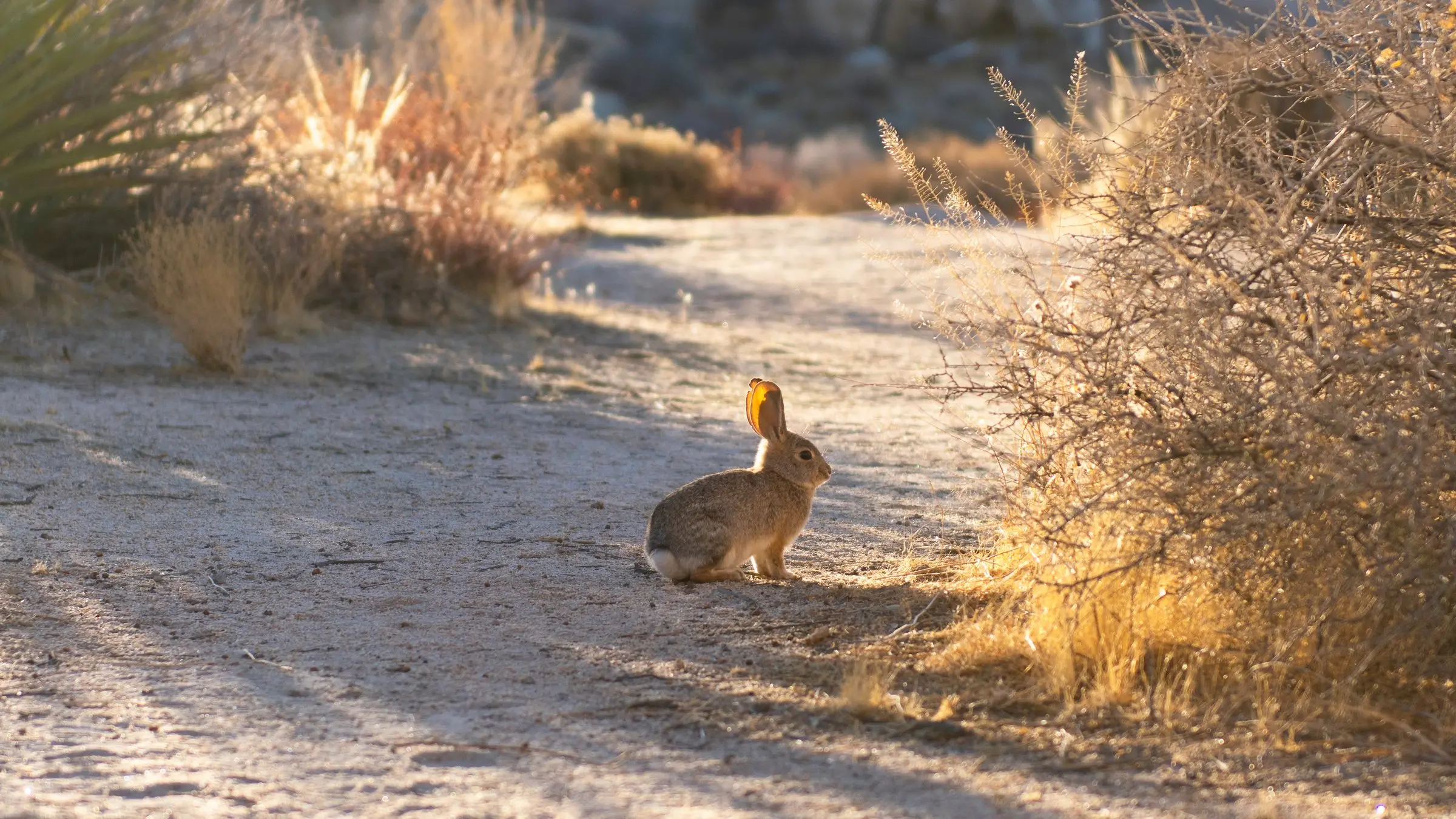
The jackrabbit is a shrub eater that everyone treats as a grass eater
This is the one that surprised me most, and it changes where you look for them.
The Forest Service’s species review puts the seasonal split plainly:
“Shrubs generally comprise the bulk of fall and winter diets, while grasses and forbs are used in spring and early summer.”
So the animal that carries three quarters of the coyote diet in sagebrush country is eating brush through the entire hunting season. Green grass is a spring and early summer food. By the time you are out there in October, the jackrabbits have moved onto woody plants and stayed there.
The switch is not about preference. It is about water, and I will come back to that.
There is also a browse signature, and it stays on the plant after the rabbit has gone. Martínez and López-Portillo fenced young honey mesquite away from jackrabbits and compared them with plants left exposed, in Annals of Botany in 2003. Protected plants grew normally. Browsed ones did not:
“controls had long branches and an extended crown cover, while exposed plants had short branches and a compact crown cover”
The authors describe the browsed plants as taking on a hedged architecture, “packing many stems in a compact matrix armed with spines.” That is a shrub that has been eaten for years, and unlike a track or a dropping it does not wash away in the first storm. A slope of short, dense, wide little shrubs is telling you something about the rabbit population that a single drive-by cannot.
Where they are during the day is not where they feed. The same Forest Service account describes “diurnal movement of 2 to 10 miles from shrub cover in day to open foraging areas at night.” Two to ten miles. The bedded rabbit and the feeding rabbit can be most of a section apart, and a coyote working the feeding ground at three in the morning is not on the same piece of dirt he will be on at legal light.
And the population underneath all of it moves in long waves. Jackrabbit numbers “undergo periodic peaks and lows every 3 to 10 years,” which is why a canyon that was crawling four seasons ago can be empty and both things are normal.
The cottontail will not leave the edge
Different animal, different problem, and much easier to hunt around.
Texas Tech’s Mammals of Texas account gives the number that matters:
“they seldom range >360 m (1,200 ft.) from their preferred thickets, around and in which they feed, sleep, court, and rear their families.”
Twelve hundred feet. Everything a desert cottontail does happens inside a quarter mile of a brush pile, a fence line tangle, a rock jumble or a wash with cover in it. A jackrabbit will cross open ground. A cottontail treats open ground as a thing to be gotten across.
Their food is whatever is close and green. In west Texas the same source has them eating “the leaves and green pods of mesquite, various grasses, forbs, bark and twigs of shrubs, and the juicy pads of prickly pear.” That last one is worth holding onto, because prickly pear turns up in coyote scat as fruit and pads both, and a coyote does not have to eat the cactus himself to be eating the cactus.
One detail I like, from the same account, is that in shortgrass country they are “so commonly associated with prairie dog towns that it is known locally as the prairie-dog rabbit.” A dog town is a cottontail magnet, which makes it a coyote magnet, and it is visible from a mile away.
Voles need thatch, and thatch is a management decision
Part one had a study from northeastern California where meadow voles turned up in about half of all coyote scats. Half. So it is worth knowing what a vole actually needs, and it is not grass.
It is dead grass.
The foundational work here is Birney, Grant and Baird in Ecology in 1976, which argued that voles cannot even mount a population cycle without a threshold amount of cover:
“A hypothesis is presented that a site-dependent threshold level of vegetative cover is necessary for a population of Microtus to increase in numbers sufficiently to undergo a multi-year cycle.”
They put hard numbers on it in Minnesota. Voles “tended to avoid habitat having less cover than ≈ 400 g/m²,” and the trapping split is stark. Of the stations carrying less than 500 grams per square meter of cover, only 12 percent ever caught a vole across two years. Of the stations above it, 56 percent did. Past about 600 grams, more cover stopped mattering.
That is a switch, not a slope. Below the line you get a few resident voles and nothing more. Above it you get the boom.
And here is the part that makes it usable. The paper opens by quoting one of the authors saying that given control of the gate to the cattle, he could regulate any phase of a vole cycle except the decline. Their grazed pasture site “is maintained in a constant range condition year after year through regular adjustment of grazing intensity; cover, especially litter, is always low.” The cows kept the litter down, and the litter being down kept the voles from ever peaking.
So a grazed pasture and an ungrazed corner of the same field are two different worlds to everything that eats voles. The rested field, the fenced-off riparian strip, the neglected ground behind an old corral, the county road easement nobody mows. Those are the vole factories. The pasture with cattle on it all summer is not, no matter how green it looks.
Mice and kangaroo rats live on seed, and the seed comes in pulses
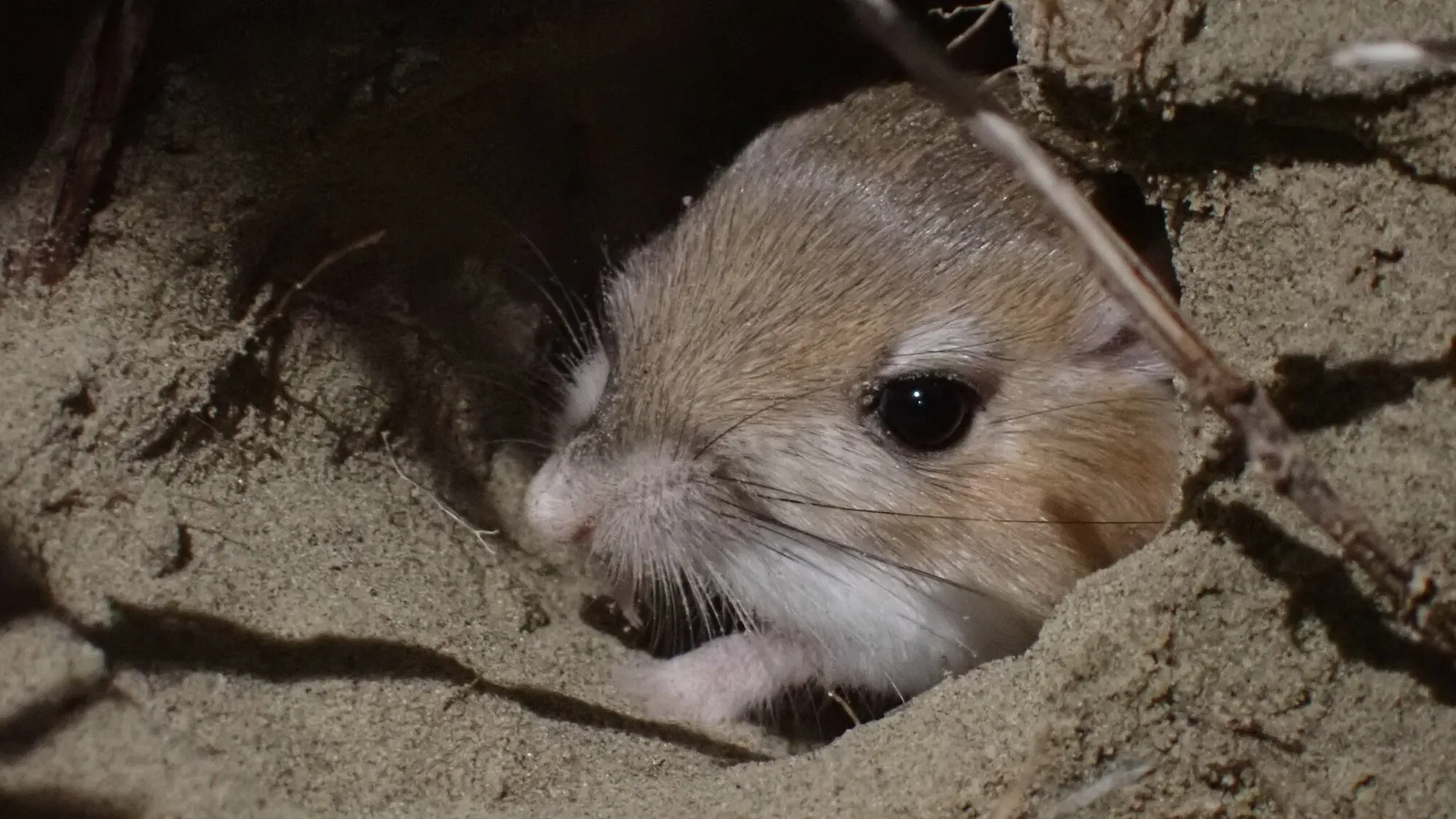
An Ord’s kangaroo rat in its burrow mouth. It will fill its cheek pouches with seed, carry it back here, and bury it in dozens of small caches. Photo by Ellyne Geurts, CC0.
Rodents are the numbers game. Part one covered the finding that coyotes eat far more rodents than lagomorphs while actually preferring the lagomorphs, and this is where those rodent numbers come from.
Deer mice are the generalists. The Forest Service calls them “omnivorous; the main dietary items usually include arthropods and seeds,” and they are “nearly ubiquitous in North America.” The detail worth carrying is regional: in Colorado pinyon-juniper woodlands, 77 percent of the deer mouse diet was pinyon seed when the seed was available. A pinyon mast year does not just feed coyotes directly, which is what the pine nut scat in part one showed. It also builds a mouse population that feeds them for a year afterward.
Kangaroo rats are the specialists, and they are the reason a sandy flat can hold more life than it looks like it should. They are “primarily granivorous and herbivorous,” and a single animal “may make tens to hundreds of caches, each with tens to hundreds of seeds.”
How hard the seed supply drives them was measured at Arches National Park over five years, published in Ecology and Evolution. Blackbrush is a mast-seeding shrub, meaning it produces heavily in some years and not at all in others. In blackbrush-dominated ground, “blackbrush seeds comprised >79% of seed production in a mast year, but 0% in the first postmast year,” and the rodents followed it exactly:
“Kangaroo rat abundance in blackbrush-dominated vegetation was highest in the mast year, declined sharply at the end of the first postmast summer, and then remained at low levels for 3 years.”
Three years at the bottom, off one failed seed crop.
Then the line that should decide where you point the truck: “In mixed desert vegetation, kangaroo rat abundance was higher and more uniform through time.” A stand of one plant boom-and-busts. Mixed country holds a steadier rodent population, year in and year out, because when one seed source fails another one does not.
There is a lag on all of this, and somebody has measured it. A study of deer mice in the northwestern United States, also in Ecology and Evolution, found that “the maximum positive effect of biomass on deer mouse abundance occurred after a 9-month lag.” Good growth in spring pays out in mice around the turn of the following winter. That is a whole hunting season of delay between the rain and the rodents.
Cheatgrass, and why it is worth learning to recognize
This is the one piece of plant identification I would push on anybody hunting the Great Basin, because enormous areas of it are now cheatgrass and the grass does not do what grass is supposed to do.
An exclosure experiment published in Ecology and Evolution ran the same test in two places. In western Asia, where cheatgrass is native, rodent foraging cut its establishment by nearly 60 percent. In the Great Basin, where it is not, the rodents had no effect at all, and the reason was in what they picked up:
“rodents in the Great Basin but not western Asia generally avoided seeds from cheatgrass relative to seeds from native competitors.”
They will eat it if there is nothing else. Given a choice they walk past it. A cheatgrass monoculture looks like grass country and feeds almost nothing, which means it holds few rodents, and fewer rodents means fewer coyotes working it.
So here is what it looks like.
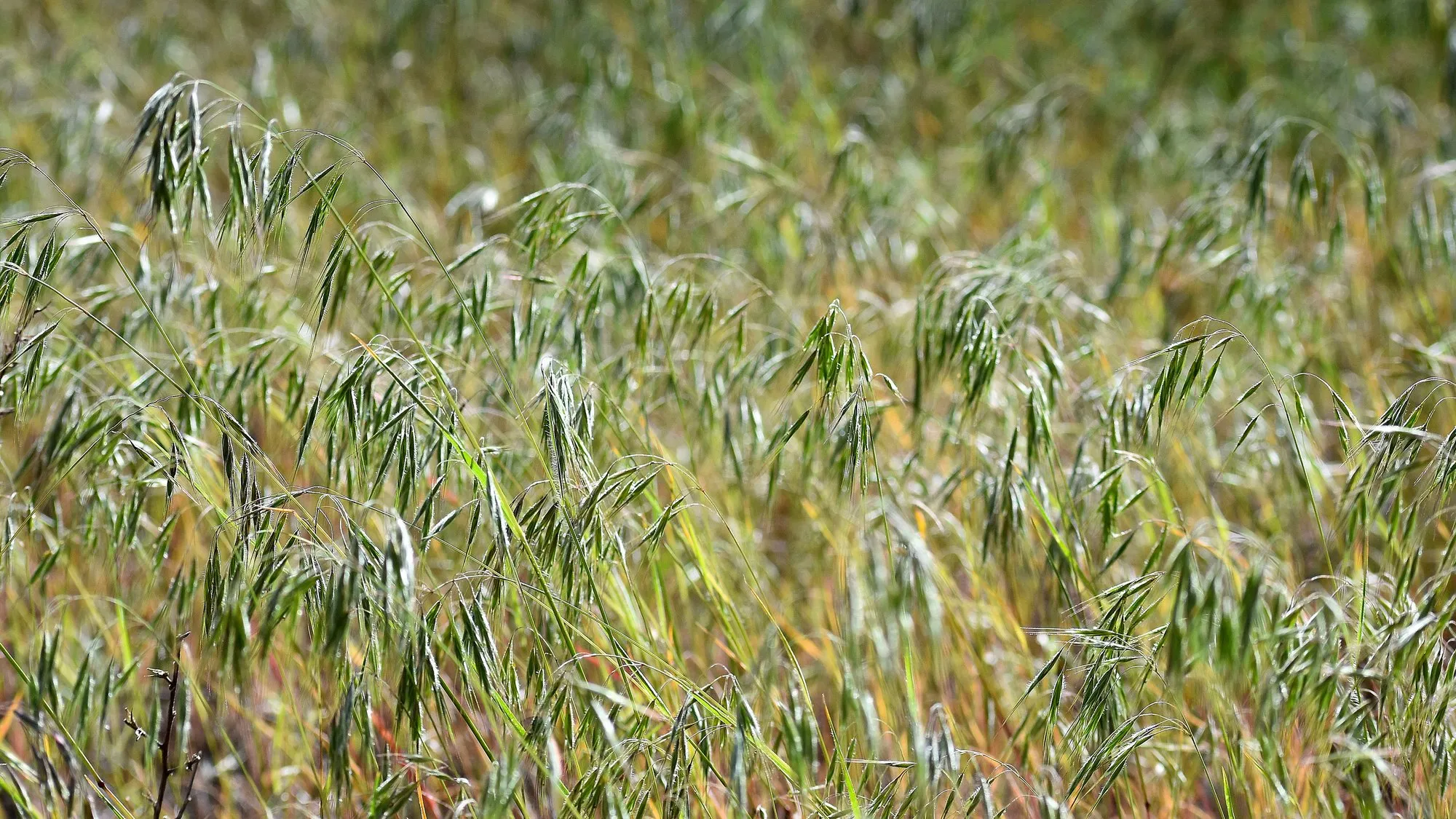
The seed head is the giveaway, and no other grass on that ground does this. The panicle branches arch over and hang to one side, so the whole head nods instead of standing up. Utah State Extension describes it as an “open, drooping, much branched panicle” with awns “5/8 inch long or longer.” National Park Service photo, Arches, public domain.
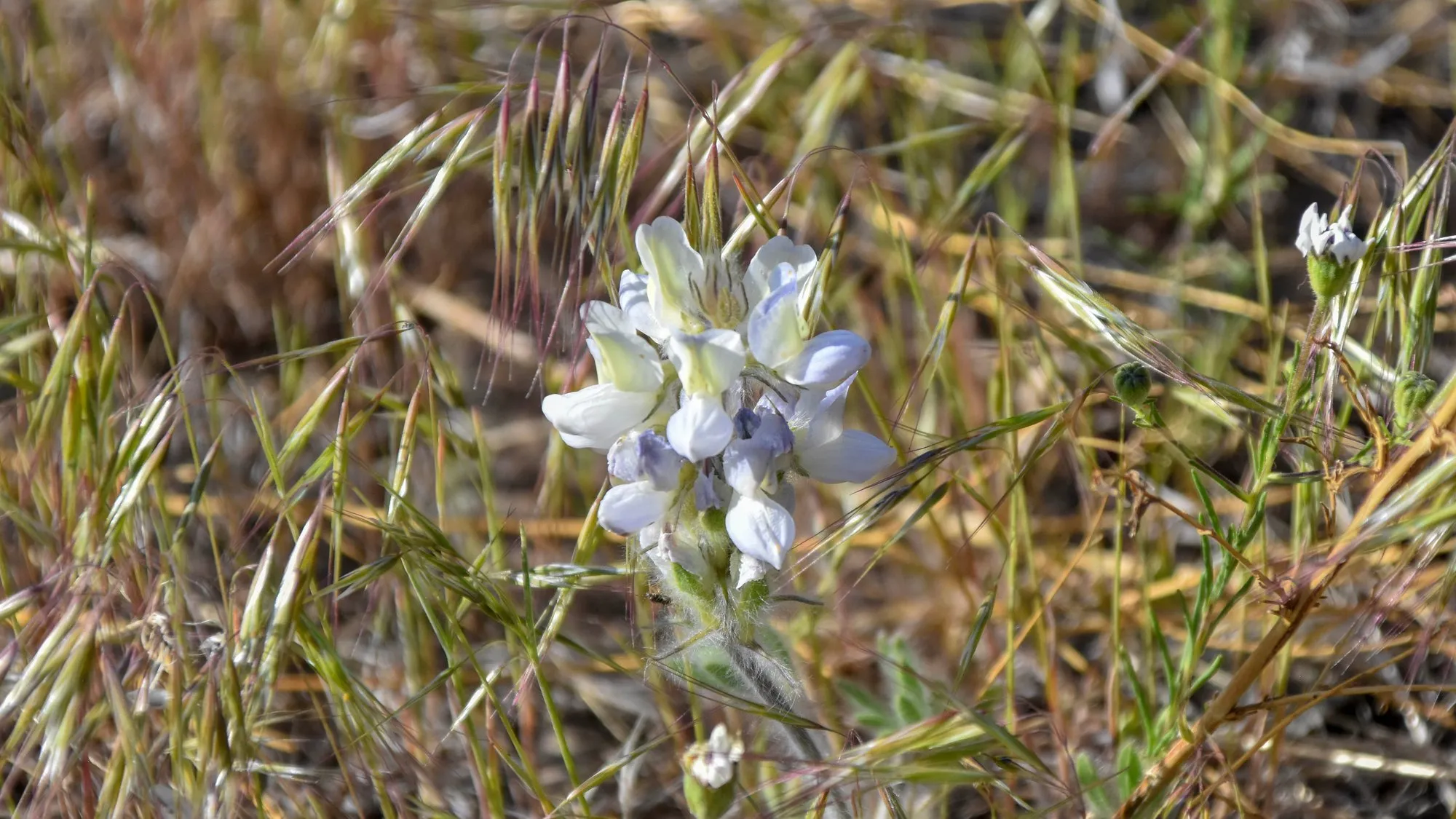
Later in the year it goes, in Extension’s words, “typically rusty-red to purple at maturity,” then bleaches to straw. The purple cast in the awns is the second thing to look for. Photo by US Fish and Wildlife Service near Reno, Nevada, public domain.
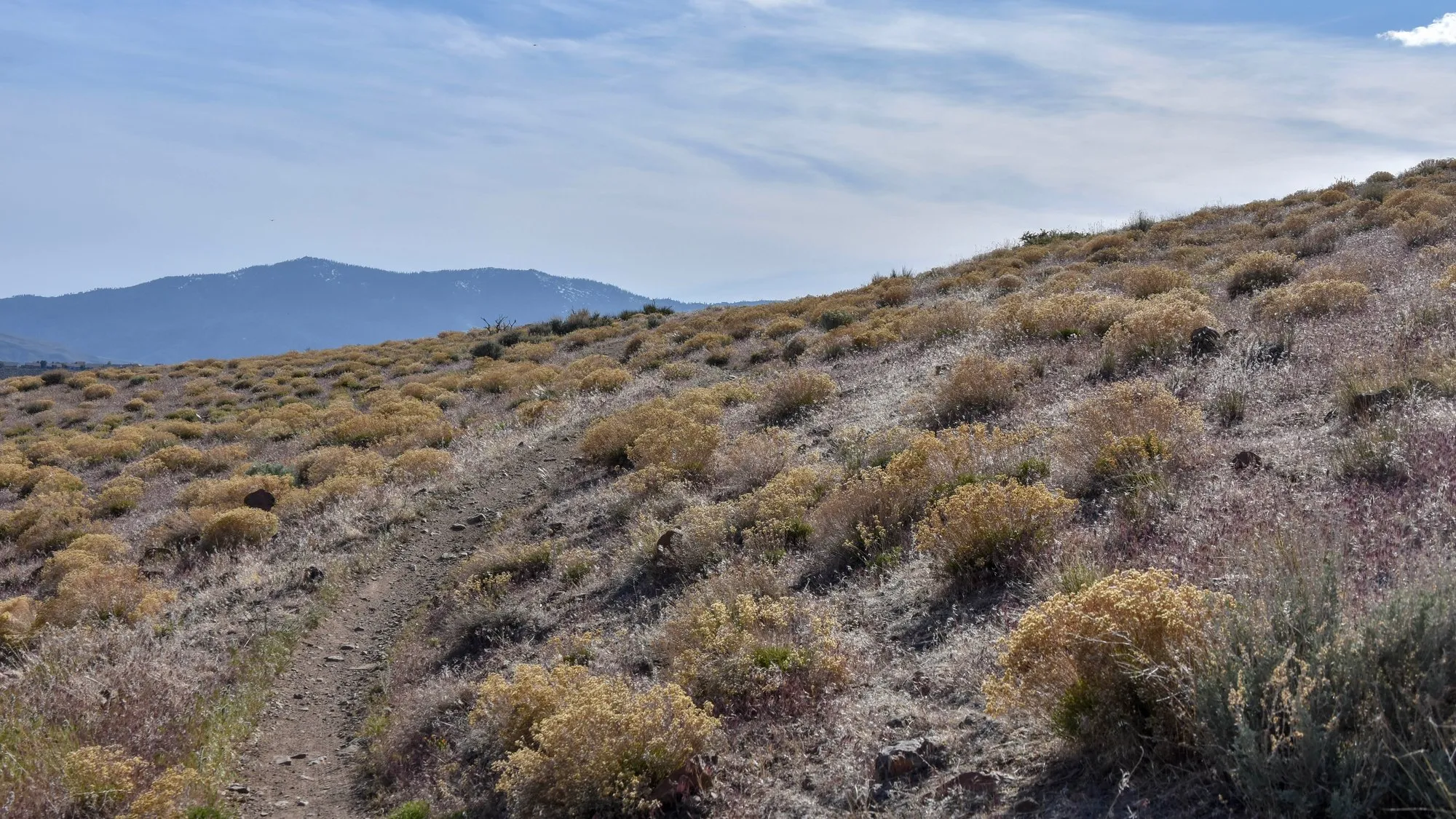
And this is what a takeover looks like from a distance. The shrubs are still there. Everything between them is cheatgrass. Photo by US Fish and Wildlife Service near Reno, Nevada, cropped, public domain.
Three other things make it easy once you know them. The leaves and sheaths are soft and hairy, so it feels different from the natives when you run it through your fingers. It is short, “2 inches to 2 feet tall.” And the timing is wrong: the seeds “germinate in the late fall or early spring,” with “seeds maturing within 2 months of beginning growth,” so it is green and already going over while the native bunchgrasses around it are still getting started.
That timing is why it wins, and it is also why it burns. Utah State Extension is blunt that “explosive cheatgrass fires are most dangerous to life and property”, and it “invades heavily grazed rangeland, roadsides, waste places, burned areas, and disturbed sites quickly.” Fire clears the shrubs, cheatgrass takes the opening, the next fire comes sooner, and each turn of that wheel takes out more of the mixed vegetation that actually held the rodents.
None of which means you should refuse to hunt it. Coyotes cross it and travel it like anything else. It means that when you are choosing between two pieces of ground, the one with native bunchgrass, shrubs and a seed mix is carrying more prey than the one that has gone over, even when the cheatgrass side looks greener in April.
How any of them get water
This is the question people ask most about desert country, and the answer surprised me.
Most of them do not drink. I went looking for where the prey animals water and found that for the most part they do not need to.
Jackrabbits run on the water in their food. The Forest Service is specific: “Most of a jackrabbit’s body water is replaced by foraging water-rich vegetation,” and the plants have to clear a bar. “Jackrabbit require a plant’s water weight to be at least five times its dry weight in order to meet daily water intake requirements.”
Five to one. That is the whole reason the diet switches to shrubs in the dry months, because “black-tailed jackrabbit switch to phreatophyte shrubs when herbaceous vegetation cures.” Phreatophytes are the deep-rooted plants that reach groundwater, and they stay wet after everything shallow has gone brown. Greasewood, rabbitbrush, mesquite, willow in a dry wash. When the grass cures out, the rabbits go to whatever is still pulling water up from below.
They also solve heat without spending water, which is what the ears are for. A 1971 study in the Biophysical Journal put jackrabbit ears in a wind tunnel and found that “convection from the ears, however, could account for the loss of over 100% of the animal’s metabolic heat at an air temperature of 30°C.” They radiate heat off those ears instead of panting it away. The catch is in the next sentence: “If air temperature exceeds body temperature, the animal must either store heat or resort to the evaporation of water.” Past about body temperature the trick stops working, which is why a hot afternoon puts them in the shade and not on the feed.
Kangaroo rats do not drink at all in any practical sense. “Most water is obtained from seeds and succulent plants,” and they “drink water when it is available but apparently do not require free water.” Dry seed, a deep burrow, and night work. That is the entire water strategy.
Which brings up the question every hunter asks, which is whether water is the magnet it looks like.
The best test I found was run at Dugway Proving Ground in Utah and published in Current Zoology. They shut off the guzzlers and watched what happened, over four years, with collared coyotes and jackrabbit counts. Two results:
“Visitations of radio-collared coyotes to guzzlers declined nearly 3-fold following elimination of water.”
“Eliminating water availability at guzzlers did not influence jackrabbit relative abundance.”
The rabbits did not care, because “black-tailed jackrabbits, on the other hand, appear to persist by utilizing preformed water alone.” The coyotes visited less, but they did not leave, did not shift their home ranges to other water, and did not die at a higher rate. The authors’ conclusion is worth reading twice:
“In other words, ‘coyote use’ of free water does not appear to translate to ‘coyote need’ for free water in our study system.”
And flatly: “free water availability is not a requisite habitat component for resident coyotes.”
The same team ran the rodent side of it and got the same answer from the other direction. They found “no evidence that water developments impacted rodent abundance,” and reported instead that “rodent abundance was primarily driven by vegetation type and year of sampling.”
So the guzzler is not a magnet. It is a convenience. A coyote will use it if it is on his way and will get along fine without it, and the prey that actually feeds him is not tied to it at all. The vegetation is the map. The water is a landmark on the map.
The thing that changed in 2020, and is still changing
If you have hunted the Southwest or the Great Basin for more than a few seasons and thought the rabbits thinned out, you were probably right. This one has reached eastern cottontails too, so it is not only a western concern, but the western die-offs are where it has been worst.
Rabbit hemorrhagic disease virus 2 reached wild North American rabbits in March 2020, first confirmed in New Mexico, and it spread fast. A surveillance summary in Viruses covering March 2020 through March 2024 reported that “313 (34.2%) lagomorphs tested positive for RHDV2 by RT-qPCR in eight native North American lagomorph species across 14 western states.” Of the black-tailed jackrabbits submitted, 77 of 106 were positive.
It has not gone away. Utah’s Division of Wildlife Resources confirmed it again in June 2026, in cottontails near Kamas in late May and in black-tailed jackrabbits in the West Desert in early June.
Three things follow for a hunter.
It does not touch you or your dog. The agency is explicit: “RHDV-2 only infects wild and domestic rabbits and hares. It’s not known to affect humans or livestock.”
Coyotes move it. The virus “can survive for months in the environment and can spread from dead rabbit carcasses or through food, water and any other contaminated materials, like the urine or feces of sick rabbits, or through contact with the feces of predators that have eaten infected rabbits.” An animal that eats a dead rabbit and travels ten miles is a vector.
A rabbit crash is a diet shift. If the lagomorphs on your ground took a hit, the coyotes did not leave. They moved down the list, onto rodents and carrion and whatever the season is offering, and the rabbit distress you have always played is a less convincing offer than it used to be. That is an argument for carrying more than one kind of sound, not for giving up on the rabbit.
If you handle rabbits at all, Utah’s guidance is to skip anything that looks sick, wear gloves, and cook to 165 degrees. Check your own state’s rules and advisories too, because several agencies have added lagomorph carcass restrictions since 2020.
What this changes on a stand
Four things, and the last one is the one I would take if you only take one.
Hunt the mixed country, not the pure stand. The Arches work is the clearest statement of it: a monoculture booms and crashes on one plant’s seed crop, and mixed vegetation “was higher and more uniform through time.” The same logic runs all the way up. Mixed country feeds more kinds of prey in more conditions, so it holds coyotes in the years when the single-species ground has nothing.
Read the litter, not the green. For voles the threshold is dead grass on the floor, and a heavily grazed pasture never gets there. Standing thatch in a rested field is worth more to you than a lush grazed one. Cotton rats in the South want the same thing, and they leave two-inch runways in it to prove they are there.
Count back nine months. The rain that matters to this season’s rodents already fell. A good spring means mice around the turn of the following winter, and a dry one means the opposite, on a delay long enough that most people never connect the two. Every region has its own version of this number, and part three has the eastern and northern ones.
And the big one: prey go where they feel safe, not where the food is. This is the finding I keep coming back to. Seven years of camera trap work in the Chihuahuan Desert, published in the Journal of Animal Ecology, tracked coyotes, kit foxes, jackrabbits and cottontails across a gradient from grassland into shrub-encroached country. The rabbits responded to wet summers, but only in the brush:
“Lagomorph prey responded strongly to bottom-up pulses during years of high summer precipitation, but only at sites with moderate to high shrub cover. This outcome is inconsistent with the hypothesis that bottom-up effects should be strongest in grasslands because of greater herbaceous food resources.”
The open grassland had more food in it. The rabbits used the brush anyway, because the brush felt safer, and the authors put the principle in one line: prey abundance “will be greater in habitats perceived as safe because of shifts in habitat selection to avoid predation, even if safer habitats have lower food resources.”
The coyotes were not fooled. In the same study, “site use intensity of both canid species was positively associated with jackrabbits.”
The prey animal is not trying to eat as well as possible. It is trying to eat without being eaten, which is a different problem with a different answer, and it puts the animals somewhere other than the feed. That holds well outside the desert, which is one of the things part three picks up.
So do not call the best feed on the property. Call the best feed that a rabbit is willing to stand in, which is usually the feed with something to hide in beside it.
Now the caution, and it is one I earned. I sat a hillside once with brush above me and called into it, because the brush is where everything lives and the research above says so. Nothing came. We flipped the setup and called the other way, out across the open, and brought in three. Killed one.
Knowing where the prey base is told me that hillside was worth sitting. It did not tell me which way to face, and I read more into it than it actually said. Reading the country tells you where to be. It does not tell you which direction he will come from. A coyote lives in the cover and travels the open, and plenty of the time he arrives from the side you had your back to.
That gap between where the food is and where the prey will use it is the whole subject of part four, along with the diagrams. Until then, scouting for coyotes covers the walking-around version, and when to hunt covers the calendar this all runs on.