
Part two was the dry West, and if you hunt Ohio or Georgia or Ontario most of it did not apply to you. No jackrabbits, no kangaroo rats, no cheatgrass, and water is not what limits anything on your ground.
This is your half. Same method, different animals.
The frame comes from the ecoregion table in part one: a rangewide analysis of 93 coyote diet studies that measured what changes from region to region. Everything east of the Rockies came out of that analysis looking different from the desert in the same direction. More deer. More fruit. Fewer rabbits than the rabbit-first habit assumes.
East of the plains, a coyote runs on venison
This is the single biggest difference, and it reorganizes everything else.
Measured against the Great Plains as a baseline, ungulate frequency in coyote scat runs 26 percent higher in eastern temperate forests and 29 percent higher in the northern forests. In the southeastern states, Jensen and coauthors put the mean at 42 percent, which they note is “on a par with the northern forests ecoregion (where ungulate consumption was highest).” Their summary of the pattern:
“Coyotes were generally more carnivorous in temperate forests than in other ecoregions, which seems to be largely driven by greater ungulate consumption in temperate forests.”
A southern coyote eats deer at a northern rate. A Pennsylvania coyote eats deer at close to it.
Scat will not tell you whether a deer was killed or found, and the authors are careful about that, writing that coyotes “seem to prioritize eating wild mammals, though more work is needed to quantify scavenging.” So treat the number as venison rather than as predation. Fawns in early summer, road kill, winter kill, gut piles in November, and whatever a coyote can pull off a carcass a larger animal opened.
The practical read is that your gut pile is a food plot. So is every deer that dies on the road along your property, and so is the carcass dump behind the processor if your state allows one. In the desert a hunter looks for the rabbit population. Here you look for where the dead deer are, and in deer season you make them.
It also explains a frustration. A coyote with a carcass is a coyote with no reason to answer a dying rabbit. If your ground is thick with deer in late fall, you are competing with an enormous amount of free food, and that argues for sounds that offer something other than a meal.
Acorns, mice, and a forecast you can make in October
The acorn is the eastern mast crop, and it has been watched for longer than almost anything in ecology. Oaks mast the way desert shrubs do, heavy some years and nothing the next, and the white-footed mouse rises and falls behind them. Part two told the western half of this story with blackbrush and kangaroo rats at Arches. This is the same machine running on different fuel.
Keesing, LaDeau, Canham, Oggenfuss and Ostfeld put two long-term datasets side by side in the Journal of Animal Ecology, a 33-year run from New York and a 39-year run from Maine. The two forests behaved differently under a warming climate. What did not change is the link itself. In New York, “mouse abundance remained tied to interannual variation in seed production,” and the review of their work concludes that “the acorn-mouse interaction is robust.”
So you have the same forecasting tool a Great Basin hunter has, pointed at a different plant. A heavy white oak drop in the fall means mice through the following year, which means a better-fed coyote population and more of them. A failed acorn crop means the opposite, on the same delay. Count the acorns under the oaks in October and you have a forecast for next season.
The other half of the eastern vegetation story is fruit. Back in the diet review, vegetation frequency came out 14 percent higher in eastern temperate forests than on the plains, which those authors attribute to “relatively high availability of wild fruits.” Persimmon, pokeberry, wild grape, blackberry, old apples gone feral in a field corner. A coyote in a persimmon thicket in October is doing the eastern version of the juniper and prickly pear diet from part one.
The eastern cottontail is on the edges
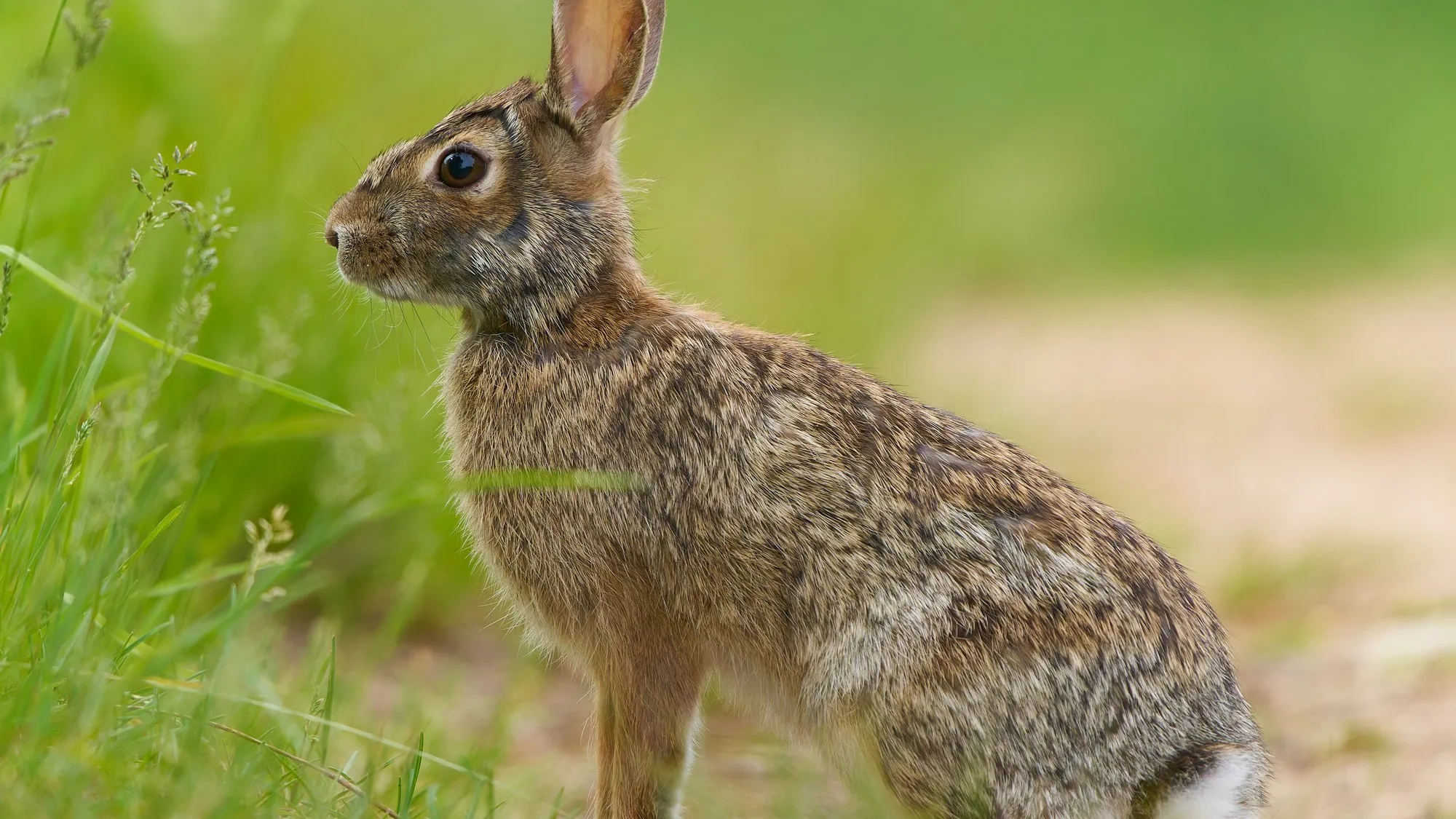
The whole rule in one photograph. Out where it can feed, tight against the cover it will use to leave. Photo by Paul Danese, cropped, under CC BY-SA 4.0.
Your rabbit is the eastern cottontail, and the rule that governs it is a number from the desert one. Texas Tech’s account of its western cousin has it ranging “seldom >360 m (1,200 ft.) from their preferred thickets, around and in which they feed, sleep, court, and rear their families,” and the eastern animal behaves the same way. It is the same rabbit in outline: a brush-dependent rabbit that will not commit to open ground, living on green forage in the warm months and on bark, twigs and buds once things go dormant. The difference is the cover it is tied to. In the West that is a wash or a rock jumble. In the Midwest and the East it is a fencerow, a brush pile, a CRP edge, a briar tangle at the corner of a field, the overgrown strip between two crop fields.
The thing to take from it is the same either way: the rabbits are on the edges, not in the middle, and so the coyote hunting the rabbits is working the edges too.
One regional correction worth making. In the southern forests, lagomorph frequency runs 12 percent below the Great Plains baseline, the lowest of any ecoregion in the analysis. So a southern hunter opening every stand on a rabbit distress is leading with a food that is a smaller part of the local diet than almost anywhere else in the country. The rabbit still works. It is not the obvious first choice the habit makes it.
Cotton rats do the vole’s job in the South
In the South the vole’s job belongs to the hispid cotton rat. Part two covered the vole rule, which is that voles need a threshold depth of dead grass on the floor before a population can do anything. The cotton rat rule is the same rule arrived at from a different direction. Texas Tech’s account has it living in “tall-grass areas where such grasses as bluestem (Andropogon), cordgrass (Spartina), or sedges (Carex) offer both freedom of movement under a protective canopy and an adequate food supply.” Protective canopy. Freedom of movement. Food. Three requirements, and cover is two of them.
They leave the same sign, too. In good cover “their runways form a network of interconnecting travel ways about 5-8 cm wide,” which is two to three inches, and once you have parted the grass and seen one you can find them anywhere. They are “primarily nocturnal but may be active throughout the day,” they eat grass and seed with insects and bird eggs on the side, and the population behaves like a vole population with the volume turned up: “hispid cotton rat populations are cyclical and subject to extreme fluctuations in density.”
Coyotes are named in the same account, alongside bobcats, hawks, owls and snakes, as the predators that “take their toll.” So a southern hunter walking a rested field looking for two-inch runways in the thatch is doing exactly what a northern hunter does looking for vole runs, and it means the same thing.
And in the Midwest it is the prairie vole and the meadow vole together, in the same places: the CRP field, the waterway nobody sprays, the grassed terrace, the ditch bank. Row crop itself is a poor host once the combine has been through. The cover on the margins is where the rodents are, which is another way of saying the coyotes are hunting the edges of your fields rather than the middle of them.
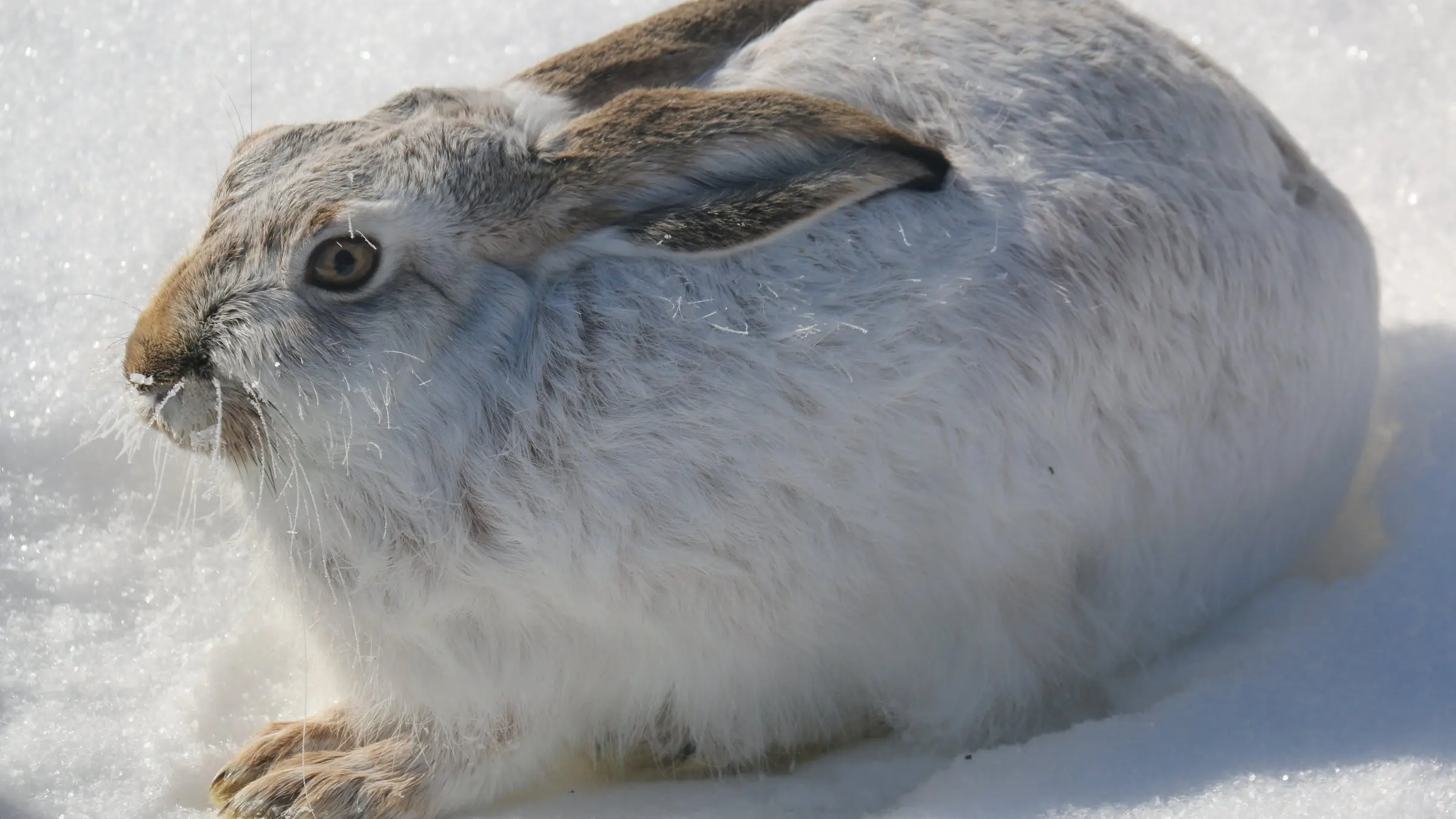
The plains and the north run on hares, and both are moving
The white-tailed jackrabbit is the plains animal, from Kansas up through the Dakotas into the prairie provinces, and it is in trouble. Schaible and Dieter, working out of South Dakota State and publishing in Great Plains Research, open by stating that “white-tailed jackrabbit (Lepus townsendii) populations in the Northern Plains have been in a general decline for the past decade or longer.” They collected 314 jackrabbits from 44 South Dakota counties to test whether body condition explained it, and found kidney fat peaking in winter and falling to near zero in summer, which they read as a breeding cost rather than a food shortage. So the decline is real and the cause is still open. If your grandfather told you about jackrabbit drives in country that has none now, he was not exaggerating.
The snowshoe hare is the boreal animal, and its cycle is the most dramatic number in this series. Krebs and a long list of coauthors gathered hare data from 1976 to 2012 across Alaska, Yukon, the Northwest Territories and northern British Columbia, published in the Canadian Journal of Zoology. Hares “fluctuate in 9-10 year cycles throughout much of their North American range,” and the size of the swing is the part to sit with:
“cyclic amplitudes (high/low) are about 20- to 30-fold, on average, with a range from 2- to 3-fold up to about 100-fold but with most cycles showing an amplitude of 10- to 50-fold.”
Twenty to thirty times as many hares at the top as at the bottom, on a roughly ten-year clock. Nothing in the desert does that, and nothing in farm country does either. If you hunt the north woods, knowing where you sit on that cycle tells you more about the coming season than any amount of scouting, and your local trapper or the provincial biologist will know.
Snow is your version of the water problem
Part two spent a long section on water, because in the desert that is the constraint people ask about. Out here the equivalent constraint is snow, and it works on the prey base rather than on the coyote.
Jensen and coauthors found ungulate consumption in coyote scat rising with snow cover across the continent, which is the northern and eastern version of the same story: a winter that piles up and crusts moves deer into a bad position, kills some of them, and feeds coyotes on what it leaves. Deep snow also buries the rodents under it, where a coyote has to hear them through a foot of crust rather than see them. A hard winter in Minnesota shifts the diet the way a dry summer shifts it in Nevada.
There is a second effect on top of that. Deep snow buries the rodents, and a coyote that could see a vole in October has to hear one through a foot of crust in January. That is why the mousing you watch in a fall hayfield turns into something slower and more deliberate in midwinter, and it is part of why the diet swings toward carrion exactly when the carrion is most available.
So read your snow the way a desert hunter reads his rain. A deep, crusted winter means dead deer and hungry coyotes working hard for rodents. An open winter means the small mammals stay available and the deer mostly live, and the coyotes are less desperate and less predictable.
Ground that looks like habitat and feeds nothing
Cheatgrass is the western version of this, and part two has photographs of it. East of the plains the plant is different and the principle is identical. Every part of the country has something that took the ground and gave nothing back to the prey base. In the East and the Midwest it is more often multiflora rose, autumn olive, bush honeysuckle or a fescue monoculture in what used to be a mixed old field. Ask your state extension office or your NRCS district which one is eating your county. The question you are asking is the same question: is this ground feeding anything, or does it just look like it is?
What this changes on a stand
Four things, and they line up against the western list rather than replacing it.
Find the dead deer. A quarter of the western diet arrives dead and the eastern share is higher. Gut piles, winter kill, road kill and carcass dumps are the highest-density food on your ground for part of the year, and they are the reason a coyote ignores your call as often as they are the reason he is there at all.
Count the acorns in October. A heavy drop means mice through the following year and a better-fed coyote population behind them. A failed crop means the opposite on the same delay. It is the one prediction on this list you can make by looking at the ground for ten minutes.
Hunt the edges, not the middle. Eastern cottontails will not commit to open ground, and cotton rats will not leave the thatch. Fencerows, CRP edges, briar tangles, the strip between two crop fields, the ditch nobody mows. That is where the prey is, so that is where the coyote hunting it is working.
And know where the hare cycle sits, if you hunt the north. A twenty-fold swing on a ten-year clock is a bigger signal than anything you will find scouting, and a trapper or a provincial biologist can tell you in a sentence which side of it you are on.
The thing underneath all four is the same finding part two closed on. Prey animals do not go where the food is best. They go where they can eat without being eaten, which is a different place, usually a worse-fed place, and almost always closer to cover than the feed itself is.
Part four takes that idea and puts it on the ground, with diagrams, in the transition areas where two kinds of country meet. Until then, scouting for coyotes is the walking-around version, when to hunt is the calendar, and the rules where you hunt come before any of it.